
Perfect Weekend: A Table for Two Among the Vines
|
*** Exclusive Offer for Finews Readers (2 guests) ***
Exclusive rate for finews.com readers: 990 euros (VAT included), excluding local tourist tax.
This offer and the following article are part of a commercial collaboration between the Lalique Group and finews.com. |
At Château Lafaurie-Peyraguey, just a stone’s throw from the legendary Château d’Yquem, French chef Jérôme Schilling (two Michelin stars) has been orchestrating one of the most brilliant gastronomic expressions in the Sauternes region. Alongside sommelier Romain Iltis, he is one of the longest-standing culinary companions of Swiss entrepreneur Silvio Denz, within what has become a true gourmet empire.
finews.ch had the pleasure of discovering this unique universe last year (article in German): a medieval château surrounded by vines, a luminous restaurant designed by Mario Botta, finely crafted menus centered on the region’s sweet wine, and a house cocktail based on Sauternes—surprising and elegant. Everything here evokes a refined vision of the terroir, far from the cliché of a dessert wine.
Since that visit, things have evolved further: Jérôme Schilling represented France at the Bocuse d'Or, the world’s most prestigious culinary competition. As a coach of a nine-person team, he supported young chef Paul Marcon—holder of three Michelin stars—on the road to victory. An unforgettable human and professional adventure, lived with rare intensity.
In this interview, Jérôme Schilling reflects on his deep connection to Sauternes, his culinary philosophy, romantic dinners in the vineyards, and the core values passed on to him by his parents.
Mr. Schilling, let’s start with Sauternes. What does the word evoke for you?
To me, it’s an incredible aromatic palette. When you taste a glass of Sauternes, you discover a richness of aromas you won’t find in any other wine. Depending on the vintage, you might sense white flowers, candied citrus peel, elderflower, stewed or caramelized pineapple… an enchanting complexity. Sauternes is all that: an aromatic density that tells a story with every sip.
And how did you discover this wine personally?
It was during my childhood. My father had family in Bordeaux. One day, during a festive meal, he opened a bottle of Château Guiraud 1977. That memory stayed with me for life. The cork was covered in tartar crystals—like little stars. My father was already sharing his passion for wine with me, letting me smell the corks… That bottle amazed me. And later, when Silvio Denz acquired Lafaurie-Peyraguey, I had the opportunity to fully immerse myself in this unique terroir.

Restaurant Lalique at Château Lafaurie-Peyraguey.
What role does Sauternes play in your gastronomic concept?
We really wanted to break the mold. Too many people associate Sauternes with a wine that’s too sweet, served too warm, and only fit for foie gras or dessert. Here, we serve it between 9 and 11 degrees, in small glasses, to highlight its freshness. And we pair it with fish, meats, sauces, shellfish… You have to relearn how to enjoy it—with cocktails, at the table, with surprising pairings.
So a visit to Lafaurie-Peyraguey is centered around Sauternes?
It’s a central part, yes. The château is 400 years old, a Premier Grand Cru Classé and neighbor of Yquem. Silvio Denz created a five-star Relais & Châteaux hotel here, with rooms decorated by the Lalique manufactory. There’s an oenotourism experience where guests can understand the morning fog, the magic of Botrytis cinerea—this noble fungus that concentrates sugars… Visitors leave with a completely transformed view of Sauternes.
Beyond the wine, what makes the experience at the Château so unique?
The people. The warm welcome at reception, the feeling of being at home, a bubble of serenity. We want our guests to completely relax. And then there’s the cuisine, of course, but also the history of the place. Every detail is considered. Being part of the René Lalique group makes a huge difference.
How does the Lalique group influence the experience on site?
I've been working with the group for almost ten years. I helped open Villa René Lalique, Château Hochberg, Glenturret in Scotland… Each site has its own identity, but we maintain a consistent standard of quality and values. Silvio Denz even hires a historian for six months before each opening to understand the story behind each place and shape the project accordingly. That soul is present in every Lalique property.

Accommodation, «Relais & Châteaux» style: Duplex suite at Lafaurie-Peyraguey. (Image: Agi Simoes & Reto Guntli, Courtesy)
Let’s talk about your cuisine—how would you define it?
They call me the «vineyard chef.» My entire menu is inspired by the world of wine. I work with vine shoots, grape leaves, verjuice, grape seeds—even certain vintages inspire dishes. One dish is based on the tasting notes of the 1976 vintage; another features fish confit in grapeseed oil, with an elderflower vinaigrette… It’s a narrative cuisine, rooted in the terroir and in René Lalique’s universe—his three Fs: Femme, Fauna, Flora.
Do you have any current development projects?
Yes, since last year. We opened «La Terrasse de Lafaurie,» a more accessible offering with open-air brasero cooking. We cook in front of the guests—13 types of vegetables, flambéed, deglazed… Guests choose either meat or fish, but the focus is on vegetables. It’s a sustainable approach. The hotel is now open seven days a week from May to October, with concerts, four-hands dinners—I’ll soon be welcoming a Luxembourgish chef and a three-star chef from Singapore.
And the terrace concept—was that your idea too?
Yes. I assign one of my fine-dining chefs to it. The idea is to revisit the estate’s agricultural roots before winemaking. For instance, we serve a vegetable platter styled like seafood—plated like oysters, but with grilled vegetables. Less animal protein, more plants—for well-being and for the planet.
Let’s talk about the Bocuse d’Or. You were involved in this prestigious competition…
Yes, it’s the equivalent of the culinary Olympics. An incredible human adventure. You start with national selections, then continental competitions, and finally the world final in Lyon. It takes a year and a half of preparation. I was assistant coach for the French team, alongside Paul Marcon (the candidate) and Christophe Quentin (our head coach). There were nine of us in the core team: chefs, former Michelin-starred talents, logistics, writing, mental support… And we won the world title.
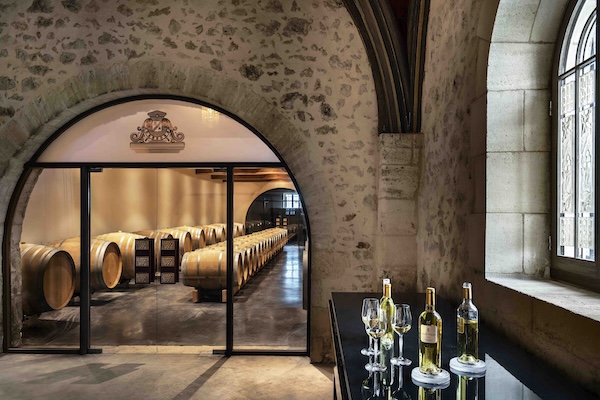
View from the old chapel towards the wine cellar. (Image: Courtesy)
How do you manage a team with such diverse talents?
It’s about cohesion and humility. Every chef has their own style, but it’s essential to let the candidate decide, after taking everyone’s feedback. We did dry runs, simulated events, and big-name chefs like Michel Roth or Pierre Troisgros came to taste. But in the end, Paul had to stand by his own choices. That chemistry, that absence of ego, is what made us successful.
Do you have a favorite spot in the region?
Yes, the Basque Country. I don’t go often, as I dedicate all my time to the Château, but I love that area. It’s hilly like Austria—where I used to go as a child. Generous nature, strong agricultural traditions, an authenticity that speaks to me.
What kind of experiences do you offer to couples for a «Perfect Weekend for Two»?
So many! Electric bikes to tour the vineyards, picnics on the Dune du Pilat at sunset, evenings at the Bordeaux opera, walks through the Landes, visits to historic castles like Cazeneuve, truffle farms, concerts on the terrace… But perhaps the most romantic and unforgettable is our private dinner in the vineyards. In summer, we move a fine-dining table—normally inside the glass veranda—directly into the middle of the vines. Just for two, with a view of the sunset, in total peace. The service is discreet and refined; the menu is bespoke. A magical moment in the heart of Sauternes. Some guests even choose it as the setting for a marriage proposal.
What’s the most important lesson your parents taught you?
Respect. For every person. We don’t all move at the same pace, and we must know how to support others—professionally and personally. To help, to be present—even financially if needed. These are simple but essential values I hold deeply.
Do you have many Swiss visitors?
I had quite a few at first. The Swiss are curious and very supportive of one another—they come to see what a fellow countryman is doing. I’d love to welcome more. They’re disciplined, respectful people I appreciate enormously. And not just because my boss is Swiss… (laughs)
Born in Alsace and trained in the kitchens of France’s great culinary masters, Jérôme Schilling forged his path under luminaries such as Joël Robuchon, Roger Vergé, and Thierry Marx. A Meilleur Ouvrier de France since 2023, Schilling is known for his precision, creativity, and deep sensitivity to terroir. His cuisine is rooted in the world of wine—a passion expressed in many dishes at Restaurant Lalique in Château Lafaurie-Peyraguey, where he has served as Executive Chef since 2018. Dubbed the «chef of the vines,» he crafts refined, narrative menus inspired by Sauternes and the heritage of Bordeaux. Under his leadership, the restaurant has earned two Michelin stars and become a destination of gastronomic excellence.
|
*** Exclusive Offer for Finews Readers (2 guests) ***
Exclusive rate for finews.com readers: 990 euros (VAT included), excluding local tourist tax.
This offer and the following article are part of a commercial collaboration between the Lalique Group and finews.com. |