«Valser Chefs»: Mitja Birlo’s Counterpoint to Zurich’s Urban Rush
«Valser Chefs» is a new series by finews in collaboration with The Coca-Cola Company. It introduces chefs who see Valser not simply as mineral water, but as a product with origin, character, and gastronomic significance.
A main train station is not a place one automatically associates with calm. People hurry through halls and across platforms, rolling suitcases rattle across the floor, trains move past in the rhythm of the city.
And yet, right here, in the middle of Zurich’s main train station, Mitja Birlo has created something with The Counter that does not resist this rhythm so much as set something very much its own against it: concentration, precision, and a form of hospitality built not on distance, but on closeness.
Entering an opposing sphere
Anyone stepping inside leaves the commotion outside, almost as if entering another sphere. Birlo himself speaks of a «bubble» in which hardly anything of the station can suddenly be felt anymore.
This very contrast is what makes the restaurant so compelling. Outside, everyday life dominates; inside, an evening begins that is focused entirely on perception. Guests sit at the heart of the action, not far from the kitchen. They can watch dishes being plated, finished, served, and adjusted.
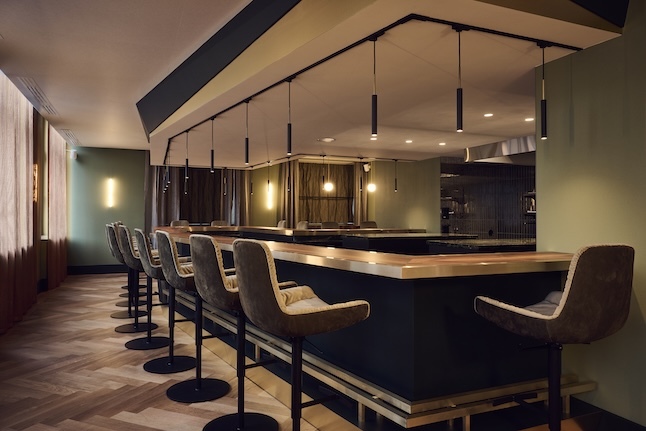
The extreme case: sitting directly at the kitchen. (Image: The Counter)
A desire for closeness and transparency
For Birlo, this is not about putting on a show. Rather, the guest becomes part of a development that says a great deal about the present state of top gastronomy. Kitchens, he says, have become ever more open in recent years, from a small glimpse through glass windows all the way to the extreme case of sitting right by the kitchen.
At The Counter, this need for closeness, transparency, and experience is pushed to the limit.
From Vals to Zurich
At first glance, the fact that Birlo is now cooking in the middle of Zurich looks like a clear counterpoint to the years that shaped him before. He spent eight years in Vals, in an environment whose pace, remoteness, and closeness to nature slowed many things down. He says openly that he liked that calm, but that at some point he also began to miss urban life again: concerts, museums, restaurants, the movement of a city.
At the same time, the counter concept had long appealed to him. He says he had toyed with the idea of implementing such a format before. When this opportunity arose in Zurich, he wanted to prove that what he had built in the mountains could also be translated into the city. The fact that this has worked, with the restaurant’s success and the accolades it has received, has noticeably taken pressure off him, he says.
Of berries, herbs, and mushrooms
Vals nevertheless remains visible in his cooking, above all in its inner order. Birlo says he learned there that something great can emerge from simplicity. Anyone who gathers berries, looks for herbs, finds mushrooms, or works with local producers develops a different relationship with ingredients. A blueberry from the forest is no longer simply merchandise, but something that carries origin, work, and history within it.
He has brought precisely this way of thinking with him to Zurich. Here, too, he is interested in where something comes from, who stands behind it, and why it matters. Working with producers around Zurich remains an important part of his work because products become more emotional when their origin is known.
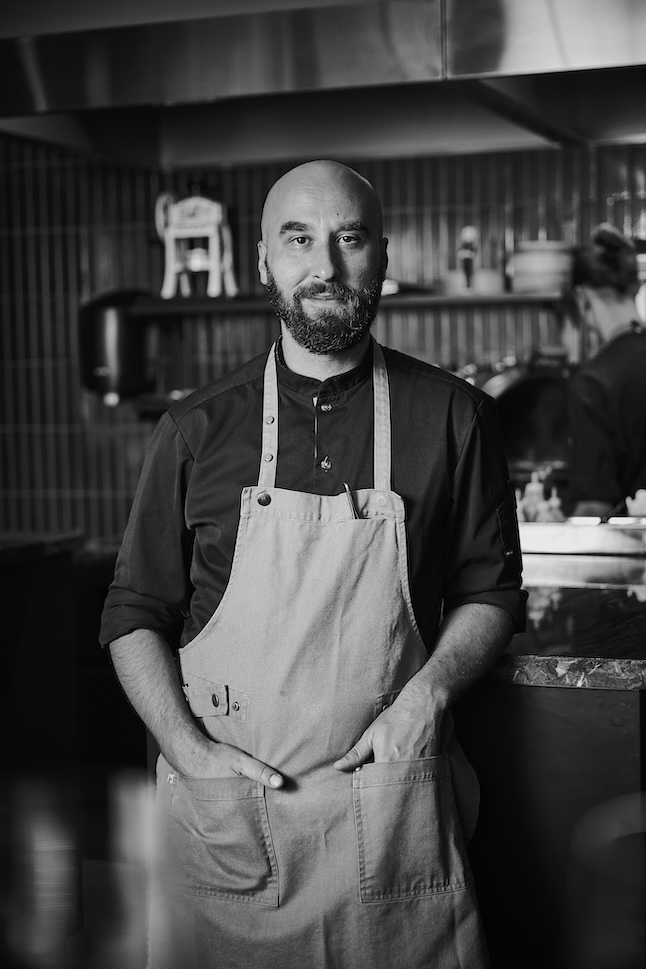
Humanity before technical perfection: gourmet chef Birlo. (Image: The Counter)
Guests matter more than GaultMillau points
Mitja Birlo speaks with unusual openness about what recognition in top gastronomy actually means. Stars, points, and entries in the relevant guides are not decorative side matters for him, but a real economic factor. He experienced that firsthand with The Counter.
After opening at the end of 2023, the first months were good. Then summer came, Zurich emptied out, and a young restaurant without stars or entries in gourmet guides has to work much harder in such a moment to be noticed. Only after the awards in autumn 2024 did the reservation books begin to fill up again noticeably. For international guests in particular, these ratings remain a key point of reference.
A restaurant has to stay in the memory
What is interesting, however, is that Birlo does not derive any self-stylization from this reality. Quite the contrary. He says of himself that he is probably one of the least dogged chefs in Zurich, perhaps even in Switzerland. What drives him is not the star for the star’s own sake, but the desire to do a good job. What matters to him is that people leave the restaurant happy, want to come back, or tell others about it. The award matters to him, but it remains a means to an end. The guest is at the center.
That may well be the key to his concept. Birlo is not interested in perfection as an end in itself. He is interested in effect. For him, a restaurant is truly good when flavors are still on the tongue the next day, when details remain in the memory, and when an evening continues to resonate.
Visible, approachable, accessible
He says openly that even in great restaurants, this has not always happened to him. All the more reason, then, why he is so preoccupied with the question of how exactly such a form of memory can be created. His answer is uniqueness and emotion, not volume and over-staging. An evening should move people, not just impress them.
This attitude suits The Counter. Guests who dine there are meant first and foremost to experience a modern concept in which the kitchen and service remain visible, approachable, and accessible throughout the evening. Some guests, he says, are initially taken aback if they have not looked into the format beforehand.
Top gastronomy between high-end and low-budget
Others, in turn, are positively surprised for precisely that reason. That is typical of a restaurant that does not want to be everybody’s darling, but instead pursues its own idea. This same consistency is also evident in the menu and in possible adaptations. The restaurant offers its menu and a vegetarian version, but is deliberately restrained when it comes to individual modifications, because otherwise the actual idea of a dish would become too diluted.
Birlo views the industry with a mixture of sobriety and sympathy. He observes that the middle is shrinking and that more and more is moving either toward high-end or low-budget. Put bluntly: people either treat themselves to a special evening, or they consciously opt for something very simple. The traditional middle is losing its appeal. It is an observation, he says, that can be seen in many cities.
Memory as the most demanding form of luxury. (Image: The Counter)
Leadership without a command bridge
At the same time, Birlo emphasizes something that is too often overlooked from the outside: top gastronomy is growing closer together. Restaurateurs help one another out, lend equipment, support one another in moments of shortage. Precisely because fine dining has become a rarer, more deliberate decision for many guests, solidarity among restaurants is growing more than elbowing competition.
Birlo also sets different priorities within his team than those once associated with top kitchens. For him, humanity comes before technical perfection. Experience is welcome, he says, but what matters is whether someone fits into the team, is passionate, wants to learn, and brings energy.
Hardly ever in the office
People with impressive résumés but difficult characters, he says, have less of a future in his system than those who truly want to pull together. Precisely because so many hours are spent together in a kitchen, there has to be a human dynamic that can carry the team. A cool, merely functional working relationship is not enough.
For him, this attitude is not just theory. He describes a model of four long working days and three days off, daily meetings, and a style of leadership in which he himself is hardly ever in the office, but remains in the middle of operations. He wants to lead the team the way he himself would like to be led: visible, approachable, and with the ambition to set an example through performance rather than merely demand it. In an industry that still wrestles with labor shortages and burnout risks, that is more than a nice line. It is an operational decision.
Why water is more than an accompaniment
The fact that Valser eventually comes up in the conversation does not feel like an obligatory exercise with Birlo. During his years in Vals, one of the water’s springs lay directly beneath his kitchen, and he describes how they experimented there with unfiltered water that was highly mineralized and rich in iron.
He says there were indeed noticeable differences in taste when using it, preserving with it, and comparing it with filtered water. Even more interesting, however, is the way Birlo thinks about water as an accompaniment. It is often underestimated in dining, he says, even though it is one of the most reliable partners to a menu.
Experience from the Graubünden mountains
For him, though, the decisive point lies deeper. Valser is not simply a brand to him; the product is tied to a place that shaped him. Images, emotions, and memories come into play automatically, he says. That is precisely why the partnership with Valser water feels credible. It is based on an experience that was already there before anyone began to frame it in communications.
Perhaps that is the real core of this story. In the middle of Zurich’s main train station, Mitja Birlo has not created a restaurant that has to assert itself through noise or pose. He has built a place that brings together precision and closeness, that expects something from its guests, and that has understood that great gastronomy today must not convince only technically. It has to remain in the memory. In a time when so much disappears again immediately, that may well be the most demanding form of luxury.
- The Counter | At Zurich Main Station | the-counter.ch
- Wednesday to Saturday from 6:30 p.m. | Saturday at lunchtime
- Reservation recommended

Peter Jauch is…
… a spirits sommelier with a penchant for top-class cocktails and likes to combine them with the best food.
… author of coffee-table books on GIN & CHAMPAGNER.
… an accomplished spirits and champagne tasting host.
… organizer of an experience festival together with friends.