
Jauch's Selection: Oriental Beauty, Discovered in Zurich
Patrik Gertschen takes his time. A personal tasting at the Markthalle im Viadukt in Zurich is exactly the right setting for tea – far better than a hasty sip between meetings. A tea leaf only reveals itself fully when water temperature, timing, and stillness come together. Gertschen is a restaurateur and selects teas for Doktor Tee in the Suedhang universe. As a tea sommelier, he handles tastings, orders, and private inquiries – at a place where wine knowledge and tea expertise meet in practice.
We work through several teas, each in small pours. The goal is not to quickly like a tea, but to understand it. Every tea gets multiple steepings, every temperature is deliberate. It quickly becomes clear how much a leaf can change when given room to open up. The first infusion sets the direction, the second reveals the real shape, and only afterward comes that quiet depth that makes tea so compelling.
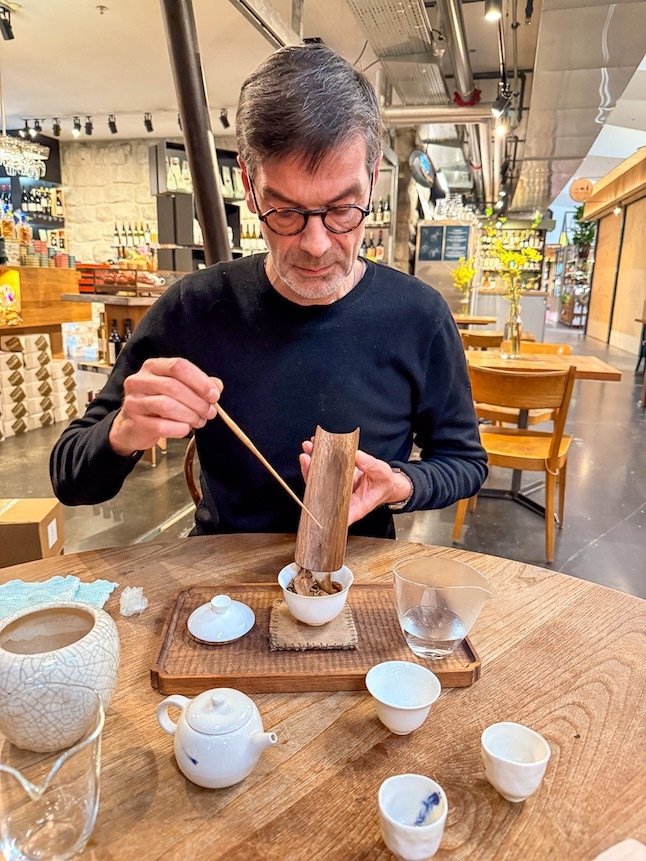
Patrik Gertschen at work with oolong. (Image: Peter Jauch for finews)
Of everything we taste, one oolong stays with me: Oriental Beauty, from Taiwan. In the cup, an image of fresh peach emerges – juicy, bright, not jammy, more like biting into the fruit than eating dessert. That peach note carries through each infusion, sometimes more present on the nose, sometimes as a soft fruity sweetness on the palate, always precise.
What Is an Oolong?
Oolong is a style family sitting between green and black tea – what defines it is the processing, not the color. After harvest, the leaves are controlled-oxidized, deliberately «aired out» and guided through the process before heat stops the oxidation. Depending on the style, this can be very light, reading closer to green tea, or significantly heavier, producing rounder, riper, and aromatically deeper results. Hence the wide range: from floral, almost weightless teas to oxidized, warm, fruit-forward types like Oriental Beauty.
The tea we tasted comes from Taiwan Organic Tea Co., sourced from the Miaoli and Hsinchu regions, and belongs to the Oriental Beauty tradition in which leaves are nibbled by small leafhoppers. This changes the plant's aromatics, producing a characteristic honeyed thread. What is remarkable is not simply that the tea smells good, but that it never feels perfumed or tips into easy aromatic richness. It remains oolong – but carries ripe fruit within it, suddenly making it culinary at the table.
That quality comes through especially clearly in the tasting, because Gertschen is not chasing «beautiful aroma» – he is asking whether a tea stays clean through the second and third infusion. Oriental Beauty does exactly that. It opens up without falling apart. It does not go flat; instead, it redistributes its weight. The peach note is very present at first, with spice and depth arriving only later. That is the difference between an ordinary tea and something you want to drink again.
Enjoyment Tool: How to Brew Oriental Beauty Properly
Oriental Beauty is an oolong that tolerates heat but rewards precision. To brew it the way we experienced it at the Viadukt, a clear structure helps: multiple steepings rather than one long cup, water around 95 degrees Celsius, and short initial steeping times that are extended gradually – so that honey, peach, and spice develop in sequence rather than being pulled from the leaf all at once.
What It Pairs With, Thinking About Tea Culinarily
Oriental Beauty works well as a close to a meal. It pairs with dishes carrying roasted notes or umami, because its ripe aromatics carry weight without feeling heavy. In a gastronomic context, that is a real quality: the tea does not impose itself, but it stays present.
The tasting at the Viadukt showed how much tea gains when it is not drowned in a large mug, but savored in small doses. Oriental Beauty from Taiwan Organic Tea Co. is the tea that most vividly demonstrates why oolong can be so fascinating: it has flavor, it develops across multiple infusions, and it strikes a balance that is rarely found – with the peach note as a throughline and a depth that only fully reveals itself after the second steep.
Oriental Beauty is available at Doktor Tee in the Suedhang universe at the Viadukt. 50 grams cost 35 Swiss francs.
«Jauch's Selection»: The biweekly finews column in which Peter Jauch precisely classifies champagne and other fine beverages and supplements them with practical service advice.