
A Quantum Leap on Lake Garda: In the Land of 97 Olive Trees
Lake Garda never quite made the top tier of northern Italy's luxury destinations. The cliché held firm: convoys of German and Dutch campervans inching along the lakefront roads, campsites packed shoulder to shoulder. Lake Como and Lago Maggiore had the prestige. Garda had the crowds.
So when word reached us of the Cape of Senses — a new lake hideaway and spa opened in 2023 by a South Tyrolean family, adults only, with views stretching across half the lake — we were intrigued. Seasoned hoteliers confirm it: Lake Garda is quietly becoming the next great destination among northern Italy's lake resorts. American travelers, always quick to spot the next thing, are just beginning to discover it.
Five Hours That Deserve Their Own Chapter
So we drove. The journey from Zurich alone — over the Fluela and Ofen passes, through the Swiss National Park and down through the Vinschgau valley — would have warranted its own story: five hours in which the landscape shifts from barren alpine peaks to apple orchards and the first warmth of the south. Put it this way: a trip through the Gotthard Tunnel is considerably less interesting.
Arriving from the north, still half alpine, the view opens up the moment you reach the lake. The water sits there like a Mediterranean painting, framed by the foothills of the Alps. The Cape of Senses sits precisely on that boundary — where the alpine gives way to the Mediterranean. The northern shore, with its high rock walls, still carries echoes of Norway; the south feels more like an inland sea. For Swiss visitors, it is closer than the Côte d'Azur and arguably more compelling than yet another trip to Ascona.
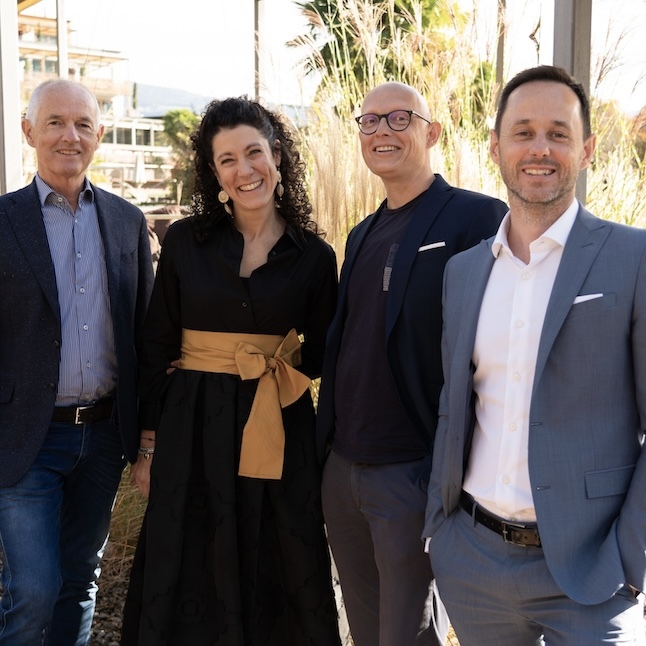
Johann Margesin (left) with Alina Deutsch (general manager of Cape of Senses) and the Margesin brothers and co-CEOs of the Cape of Senses, Christian and Johannes (right). (Image: Cape of Senses)
The Gate Opens — and the Wow Lands
To reach the hotel, you wind up a curving road from Torri del Benaco — itself emerging as a hotspot for high-end residential property. You approach from the rear: an electric gate, closed, leaving room for imagination. Christian Margesin, who developed the hotel together with his brother Johannes, explains the logic: «The guest should genuinely wonder what awaits them. Then the gate opens — and the wow arrives.» That was the architect's idea. It works.
The gate swings open, and with it half of Lake Garda. The building — designed by South Tyrolean duo Hugo and Alessia Demetz, father and daughter — curves gently along the hillside in three floors, never imposing, with green rooftops throughout. Everything faces southwest. Everything faces the water. The lake view, enjoyed in near-total silence, is the property's single most powerful selling point: the colors shift constantly — silver one moment, deep blue the next, then gold.
Architecture as a Frame for the Lake
In front of the building, a generous, immaculate lawn unfolds, interrupted only by the inviting pools and kept in check, around the clock, by seven robotic lawnmowers. There is no hour at which a petrol mower would not disturb a guest. Woven among the grass are the old olive trees: 97 in total, excavated during construction, relocated to the site's perimeter, and replanted once the building was complete. Almost all survived.
Hugo Demetz, now 75 and increasingly selective about the projects he accepts, told Margesin he needed to feel the land first — half an hour walking among the olive trees before he said yes. His guiding premise, which the family embraced without hesitation, runs through every detail: «The architecture should not distract from what we offer here.» Meaning the lake. Demetz put it this way: «When I walk into a room, the music is playing out there.»
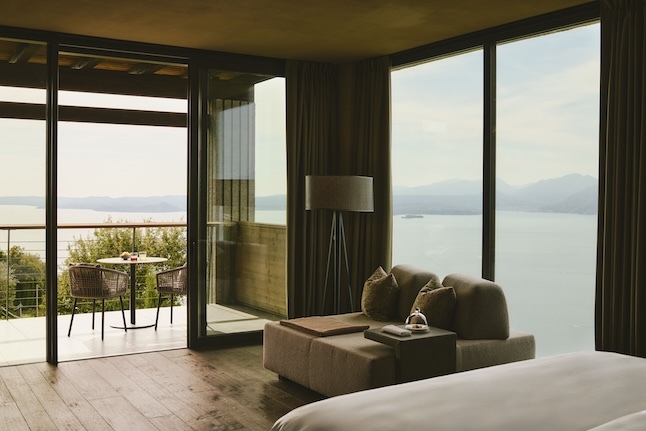
Everything faces the water: a room at the Cape of Senses. (Image: Gianni Baumann)
Two Woods, Two Stones
That discipline extends to the choice of materials. Two or three types of wood, two or three types of stone — applied consistently across all 55 suites, the bar, spa, and restaurants. The effect is a timelessness that will resist dating in twenty years. The outdoor furniture is by Talenti, the fixtures by Gessi — both Italian houses, both deliberate choices. «We wanted to build an Italian property,» Margesin says, «not a South Tyrolean copy.» On the bathrooms, the Swiss quality name Geberit is prominent. The construction expertise, however, came from home: South Tyrolean firms are accustomed to delivering hospitality projects on demanding timelines.
The spa one floor below — 2,000 square meters, three saunas, an indoor pool, a heated outdoor pool, and a sports pool — breathes the same spirit of restraint. Here too, the garden and the lake are always visible. Here too, the silence that defines the house holds. The seven treatment rooms, complete with a relaxation zone and a spa library, work exclusively with the MEI line (Miei Erbi Italiani, or «my Italian herbs»): wild herbs, hand-harvested at peak potency and concentrated through inert-gas extraction. The herb-and-olive motif flows seamlessly into the bar's cocktail menu and both restaurants.
Adults Only — a Deliberate Departure from South Tyrol
Adults only. The decision sparked a long discussion within the family. At the Alpiana, the family's home property in South Tyrol, they have spent 50 years taking pride in a multigenerational hotel, in families, in children. «In the first few months, it was not always easy when a long-standing guest called to say: you're doing something new — why can't I come?» Margesin's answer: «We didn't want to create an alternative to the family hotel. We wanted an additional space for guests who are actively seeking quiet and time for themselves.»
The meditative stillness that runs through the house is central to the concept. It is cultivated on the ground by general manager Alina Deutsch, who oversees day-to-day operations together with her team and shapes the personal character of the property.
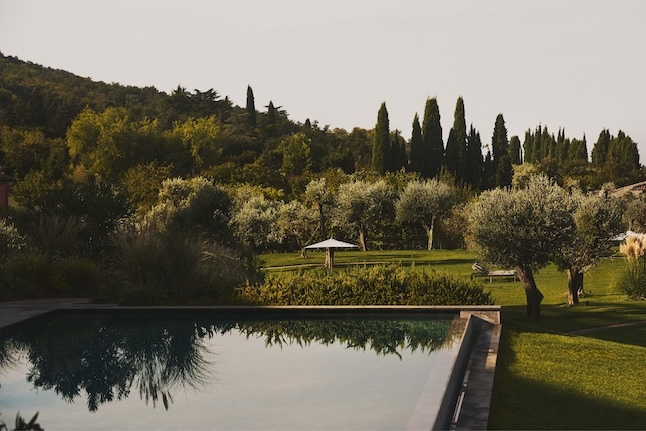
The garden of the Cape of Senses, defined by its olive trees. (Image: Cape of Senses)
A Kitchen That Doesn't Compete with the View
At the top of the building sits the Al Tramonto restaurant. At dinner, the sun drops behind the mountains of the western shore, the water transitions from blue to copper to black, and chef Gioele and his team let it happen — without pushing themselves into the foreground. Three elements per dish, precise contrasts: a deconstruction of the insalata Caprese in which the basil appears as an essence, the tomato as a purée, and the mozzarella arrives frozen. A raviolo filled with baccalà mantecato, anchovy cream, and fermented lemon. Red mullet with a herb crumble and an aubergine cream that comments on the fish without overwhelming it. For dessert, strawberries on a vanilla pannacotta spiral, a caramel lattice, and basil.
This is not a Michelin-starred kitchen — that would be the wrong ambition for this house — but it is cooking that would hold its own with ease in any well-regarded restaurant. An occasional guest who finds themselves wishing for a bolder hand with seasoning would not be entirely wrong. Half-board — included in the room rate or bookable separately at 80 euros per person — covers a choice of the daily menu, à la carte from the seasonal selection, or well-executed meat dishes from the charcoal grill. Outside guests are very welcome in the restaurant and bar, Margesin notes: «It's a way for them to discover the house.»
The MyTini, the Tiramisuper, and a Six-Euro Lager
On the terrace, with its wide-open views, bar manager Michele mixes creations priced below 20 euros whose originality sits comfortably in the top tier. For aperitivo hour, the MyTini is the recommendation — a bespoke Martini composed to personal taste, which Michele assembles after a brief conversation: crystal-clear in the glass, garnished with red fruit. Alternatively, the Negroni il Segretario pairs Whisky Segretario di Stato with St. Germain. Later in the evening, the Tiramisuper beckons, built from Kranebet Organic Gin, coffee liqueur, and whipped double cream.
In fine Italian aperitivo tradition, a black tray of house-made chips, roasted nuts, black olives, and a crostino arrives alongside — no extra charge. The small Lesster Pils — a very good beer, incidentally — costs six euros.
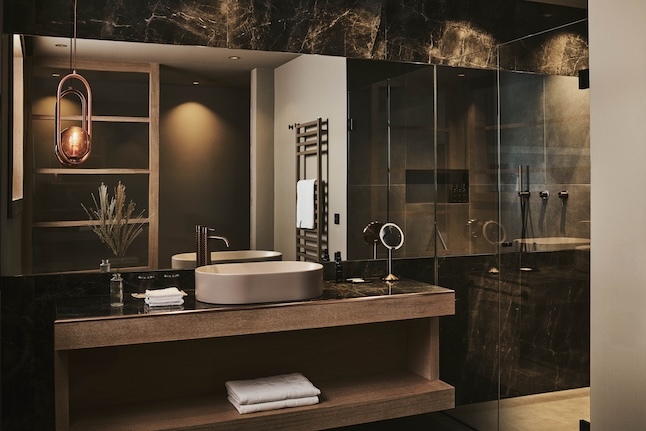
Unity of materials. (Image: Gianni Baumann)
No Ultra-Luxury Price Tag
Margesin raises the subject of pricing himself, directly and without hedging. «Just because part of the market is willing to pay 5,000 dollars for a 20-square-meter room doesn't mean you have to charge it.» American travel agents initially disagreed: too cheap, they said — it couldn't be right. «The Ferrari explains itself once the guest walks in and spends eight nights here. Then they understand they are in a hidden Ferrari.» That Modena, the real Ferrari's hometown, lies a little over an hour's drive to the south fits the picture neatly.
Three nights for two people including half-board cost around 2,610 euros in a junior suite in May, or around 2,970 euros in a suite — rising to 3,240 and 3,600 euros respectively in high summer. That is substantially less than the pricier properties in Ascona, and far removed from the new international ultra-luxury benchmark of 5,000 dollars per night.
A Base for Northern Italy
What the house offers beyond the stay itself is still taking shape. In partnership with a Swiss positioning agency, curated experience packages are being developed: private dinners in an olive grove, boat trips to secluded bays. Cycling up Monte Baldo is proving particularly popular with Swiss guests, Margesin notes. The Cape of Senses does not see itself as an island, but as a departure point: for Sirmione and its Castello Scaligero and Roman ruins, for day trips to Verona, Mantua, Bologna, for wine lovers heading to Valpolicella, for shoppers bound for Milan, or for the car enthusiast making the pilgrimage to Modena.
Christian Margesin — direct South Tyrolean German, grounded in every turn of phrase, yet with a sharp entrepreneurial clarity — describes the division of roles with his brother: «Johannes is more of a driver, a total optimist, always seeing the opportunities. Papa and I are the cautious ones. The combination works well: you always need someone who pushes forward, and someone who says — careful, you could fall over the railing.»
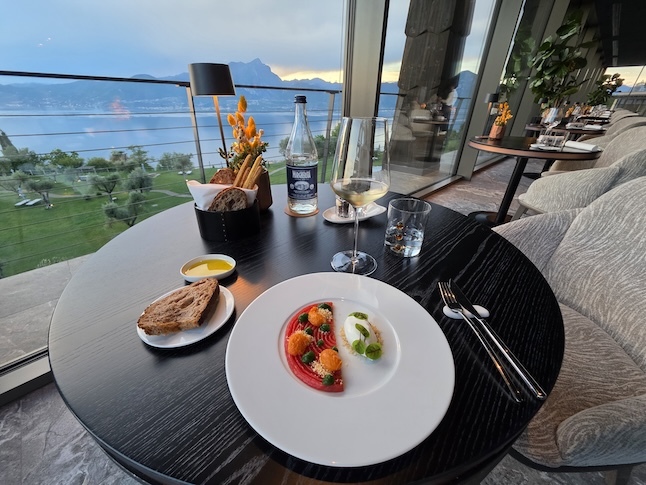
A variation on the Caprese, with frozen mozzarella. (Image: finews)
A Family Story Built on a 30-Year Horizon
The Voellaner Hof — built up by grandparents Josef and Rosa Margesin from 1975 with 25 rooms in Voellan near Lana — was a classic South Tyrolean establishment: Mama tending the bar until midnight, guests arriving in suits for the gala dinner, the hoteliers accompanying them on mountain hikes. Father Johann, who had returned from St. Gallen with an economics degree, took over with his wife Monika and began a systematic transformation. The breakthrough came in 2014: demolition, a two-phase rebuild, a renaming to Alpiana Resort, and a repositioning in the green luxury segment. The dream of a second property, this time on Lake Garda, was already decades old by then. «What Ascona is for German-speaking Swiss, Lake Garda is for us South Tyroleans,» Margesin explains.
The family's entrepreneurial instinct came from the grandfather — a man who had sold his agricultural business, against his partner's advice, just in time before the market collapsed. «Grandfather always thought roughly 30 years ahead,» Margesin says. In 2018, a chance contact led the family to the plot above Torri del Benaco: a meadow with old olive trees, jointly owned by 20 entrepreneurs from Verona, waiting two decades for a rezoning that never came. Johann's father — a man who had previously found a flaw in every plot he visited — stood on the land and gave the green light.
Building a Loyal Following — Including from Switzerland
The risk was real. «Behind this project stands not a large international group, but a family with a very clear vision,» Margesin says. Building permits did not come through until May 2022. Construction costs had exploded in the wake of the war in Ukraine. The hotel opened in July 2023, in the middle of high season, without an established clientele or a recognized name. A new property offers genuine advantages — no structural legacy, total freedom in the spa, a clear concept from day one — but the market is less forgiving than it would be with an established house.
Demand has grown steadily since. The long-term goal is to build a loyal repeat clientele. The Swiss market, Margesin believes, still holds considerable potential. He speaks openly about further expansion plans, but without urgency. Perhaps another property by the sea one day. Perhaps not. «Where we had stopped planning for the Cape of Senses,» he says, «is exactly where it arrived.»