
Bitcoin Falls, Mining Weakens – and AI is Emerging as a New Opportunity
Bitcoin has fallen sharply this year, temporarily dropping below 63,000 dollars and currently remaining more than 40 percent below its all-time high of around 125,000 dollars reached in October 2025.
However, the best way to explain Bitcoin’s recent price performance is through its resilience: The cryptocurrency is on track to end a historic five-month losing streak.
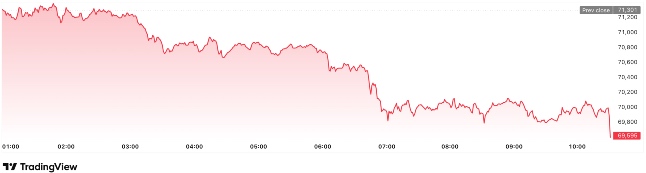
Bitcoin price development over the past 6 months (Source: Trading View)
«Bitcoin is showing the first signs of stabilising, but investors should remain cautious given the short-term factors currently dominating the market – particularly the conflict in Iran,» says Menno Martens, Crypto Specialist and Product Manager at VanEck.
Despite the volatility, Bitcoin has shown remarkable resilience since the start of the war in Iran, «significantly outperforming both the major stock indices and gold.» This further reinforces «the narrative of Bitcoin as a reliable store of value,» says Benedikt Koedel, Head of Credit and Lending at Sygnum.
Yet while price action shows early signs of recovery, the market continues to face structural pressures, particularly in the mining sector, where hash prices and profitability are increasingly under strain.
Miners Under Pressure Due to Falling Hash Price
Profitability in Bitcoin mining is under significant pressure, largely due to historically low hash prices, which have fallen more than 50 percent since the 2024 halving and currently sit around 33 dollars per Petahash (PH) per second.
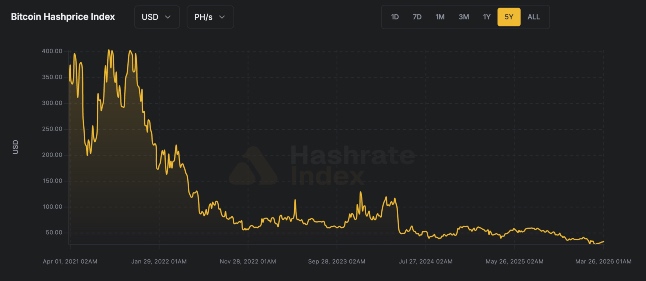
Bitcoin hashprice index (2021-2026): Mining revenues per unit of computing power have fallen sharply, highlighting mounting pressure on miner profitability (Source: Hashrate Index)
«At the current price level, the situation in the mining sector is definitely tense. Hash price is under massive pressure due to the historically high network hash rate,» argues Fabio Cavelti of T4 Capital T4 Capital. He notes that «Competition is high, and operators with older, less efficient hardware are seeing their margins melt away.»
According to Martens, miners’ reserves have been declining since the end of 2023, suggesting that many are having to sell their earnings to cover running costs and investments. «If the Bitcoin price remains weak or moves sideways, further operators are likely to be forced to cease operations or increasingly switch to AI as their reserves dwindle.»
The increasing efficiency of modern application-specific integrated circuits (ASICs) and the rapid expansion of new mining capacity are also pushing hash prices lower.
Mining Becomes a «Power Dumping Tool»
As Koedel notes, «Miners are increasingly using mining flexibly for heat recovery, methane utilization, or grid stabilization – wherever electricity is cheap.
This flexibility will further depress the hash price in the long term, as mining becomes a ‹power dumping tool›; profitability now depends primarily on energy prices and efficiency.»
Bitcoin Operators Pivot to AI
A growing number of industry players are now redirecting their infrastructure toward artificial intelligence and high-performance computing.
«This shift is real and accelerating, as miners increasingly repurpose their infrastructure toward AI and high-performance computing, where gross margins are currently far more attractive than in pure Bitcoin mining,» says Martens.
Cavelti points to a broader transformation of the sector: «Many large mining companies (IREN, TeraWulf, Cipher, etc.) have evolved into digital infrastructure firms and are investing billions in AI data centres,» as they monetise their key asset — access to large-scale energy and grid connections — through more stable, long-term contracts with tech companies.
Expansion of the Business Models
However, not all observers see this as a permanent shift. Head of Research at Bitcoin Suisse, Dominic Weibel says, «We currently see no shift away from mining, but rather a strategic expansion of the business models of many operators.»
Similarly, Darius Moukhtarzadeh, Crypto Research Strategist at 21shares, describes it as «more of a cyclical diversification than a structural departure from Bitcoin mining,» driven primarily by margin pressure, with mining likely to remain the core business once market conditions improve.
Still, the scale of the trend is hard to ignore. As Koedel notes, «almost every public miner is already evaluating or pivoting to AI data centres,» highlighting how the operational expertise built in Bitcoin mining is becoming a key asset in the race for AI infrastructure.