
Credit Insurer Expects more Bankruptcies - Record Level in Switzerland
The credit insurer forecasts a 6 percent increase in global insolvencies in 2025, and the number of corporate bankruptcies is expected to rise by another 5 percent in 2026. Only in the following year is a slight decline of -1 percent anticipated.
In Switzerland, the number of corporate bankruptcies is expected to rise by 26 percent this year to around 10,900 cases, according to the study published on Tuesday.
«In Switzerland, a new record for bankruptcies is emerging for 2025,» warns Jan Möllmann, CEO of Allianz Trade Switzerland. «This is already the fifth consecutive increase.» The figures do not yet include special cases of dissolutions due to organizational deficiencies under Article 731b of the Swiss Code of Obligations (OR).
Over 10,000 Insolvencies also Expected in 2026
For 2026, a slight decline of 7 percent indicates a potential turning point. However, this is expected to be modest, and with more than 10,000 insolvency cases, the level will remain high.
Experts point to economic and financial fundamentals and below-average growth rates as contributing factors. The tariffs imposed by the United States have further clouded the outlook.
Development of Corporate Insolvencies in Switzerland
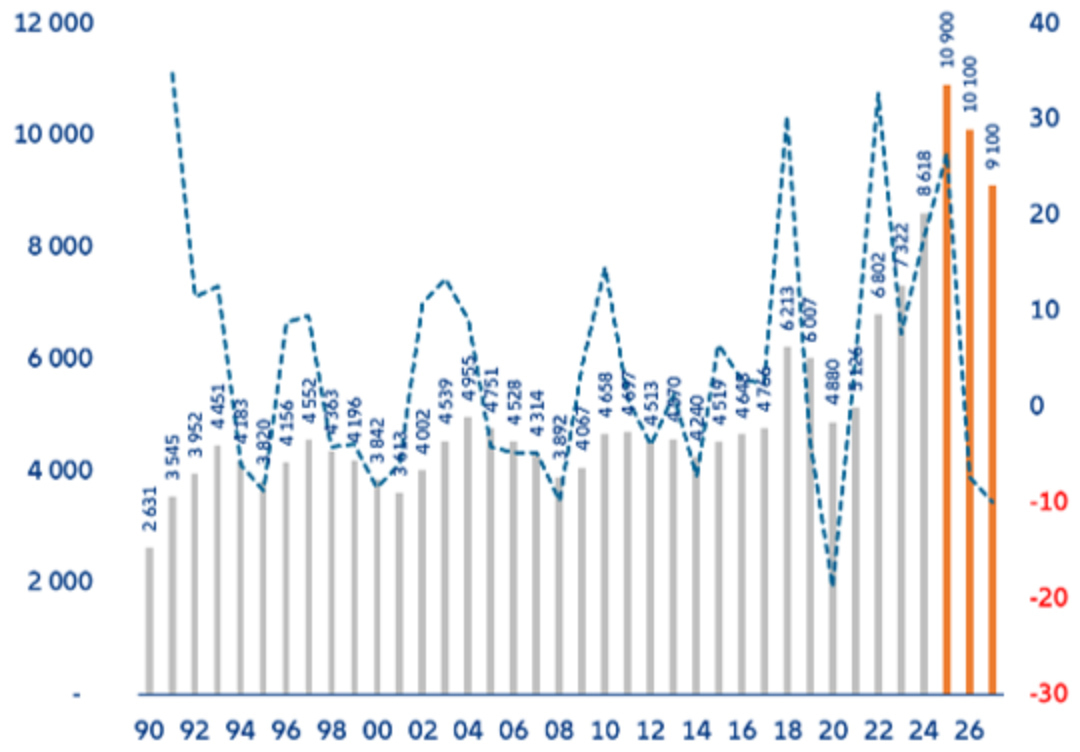
Annual number of corporate insolvencies and year-on-year change in percent (right scale). (Graphic: Allianz Trade)
The study also notes that the reform of bankruptcy law, which has been in effect since January 1, will inevitably lead to an increase in the number of companies against which insolvency proceedings are opened. Public-law claims (such as VAT, taxes, and social security contributions) can now directly trigger bankruptcy proceedings for companies registered in the commercial register.
U.S. Trade Policy and Tariffs
Globally, the analysis focuses in particular on the effects of U.S. trade policy and punitive tariffs. Experts warn that the tariffs' full impact may not be felt until 2026, raising concerns about potential ripple effects across the economy. By year-end, the effective rate of U.S. import tariffs is expected to reach 14 percent. However, this will have very different effects on companies worldwide.
«U.S. companies are currently in a relatively comfortable position, benefiting from price adjustments by foreign exporters and from the widespread rerouting of goods via third countries such as India and Vietnam. As a result, additional costs and bankruptcies remain limited,» the report continues. However, if global trade slows down, several export-dependent economies could feel the effects even more strongly.
Resilience Put to the Test
The Allianz Trade experts highlight three critical vulnerabilities that could test the resilience of companies: the persistently subdued economic growth, the partly strained financing conditions, and industry-specific risks.
Structural change, technological disruption, and intensified competition are cited in this context — particularly in the construction and automotive sectors.