
The Power Players: Switzerland’s Strongest Banking Brands
David Haigh is not just another brand consultant — he is the founder of Brand Finance, a refined statistical methodology that applies financial rigor to measure and quantify brand value. For nearly 30 years, he has been pioneering this field with a level of methodical precision rarely seen in marketing.
His valuation models and brand strength assessments are widely recognized and even certified by public treasury authorities and professional bodies such as HM Revenue & Customs in the UK, the IRS in the US, ICAEW Chartered Accountants, and the International Valuation Standards Council (IVSC).
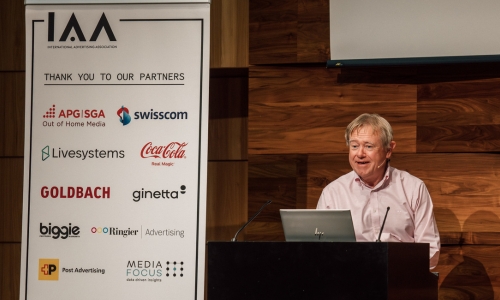
David Haigh at the IAA event in Zurich. (Image: Courtesy)
Last week, at an event hosted by the Swiss chapter of the International Advertising Association (IAA), Haigh presented Brand Finance’s methodology to a Swiss audience for the first time. His approach centers on two pillars: brand strength and brand value. Brand strength is determined by an extensive survey of over 175,000 respondents in 40 countries, measuring factors like familiarity, credibility, and emotional appeal. Brand value, in turn, is derived statistically from changes in brand strength and company revenues, applying a rigorous «royalty relief» methodology commonly used in financial analysis.
In his latest study, Haigh also evaluated 15 Swiss banks, offering a detailed snapshot of their global brand ranking (see table below the article).
finews.com had the opportunity to sit down with Mr. Haigh — 66 years old, wearing an impeccable suit, with tempered manners and a ready sense of humor — to discuss the secrets behind Swiss brand power, especially in finance and luxury.
Mr. Haigh, Rolex ranks as one of Switzerland’s strongest brands. Why is that?
Rolex is technically the second most valuable Swiss brand — Nestlé is still number one — but Rolex is by far the strongest. Interestingly, it started off in London, founded by a German entrepreneur. The brand moved to Switzerland around the First World War, and the name «Rolex» is actually an abbreviation for «Horological Excellence.» What makes Rolex so successful is consistency: in quality, in design, in everything. The Oyster model, for example, is instantly recognizable, and their product line doesn’t change dramatically from year to year. They also invest heavily in marketing and sponsorship — Wimbledon, The Masters, golf majors — you see Rolex everywhere. It reinforces the brand image in a way other watchmakers don’t manage.
Does branding work differently in finance compared to luxury goods?
Yes — but there’s a common denominator: trust. That’s the foundation of any strong brand. The kind of trust may vary: in banking, it’s about access, security, and safeguarding your money. In luxury, it’s about quality, design, and credibility. In cars, interestingly, people care a lot about environmental responsibility — even though cars are inherently not that eco-friendly.
Among Swiss banks, Julius Baer ranks highest in brand strength. Why is that?
High familiarity and visibility. In 2023, Julius Baer ran a major campaign. The bank has a strong presence and is widely recognized — and that matters. It’s the first step in any marketing funnel. Interestingly, despite past scandals or mismanagement, the brand has remained resilient, staying among the top three. That’s what a strong brand does: it helps you recover.
Credit Suisse, in contrast, collapsed in March 2023. Was it a strong brand back then?
We tracked the brand for years. It’s sad, really. Many people liked Credit Suisse — they offered good service, had Roger Federer as an ambassador, and did many things right from a branding perspective. But you can’t brand your way out of incompetent management.
And how has UBS fared since taking over Credit Suisse?
In the first year after the March 2023 acquisition, UBS’s brand value jumped 35 percent. Since then, growth has leveled off to around 2–3 percent annually. The challenge is digestion: integrating a rival of that size is difficult, especially when cultures differ.
The combined pre-merger brand values of UBS and Credit Suisse were higher than UBS’s current brand value. Why?
Our methodology is revenue-based. We ask: if you didn’t own this brand and had to license it, how much would you pay as a royalty? That rate — usually a percentage of revenue — is how we calculate brand value. If revenue drops, brand value drops. And with banking revenues flattening since interest rates spiked a few years ago, we’ve seen that reflected in valuations.
Overall, the best days of Swiss banking in terms of international brand value seem over: their cumulative value is $21.9 billion, representing 1.3 percent of global banking value, down from a peak of 3.9 percent in 2008. How do you explain that?
The fall in Swiss banks’ share of global banking brand value can be attributed to several converging factors. Firstly, the overall brand-value pool has grown faster elsewhere, driven by the meteoric rise of Chinese and US banks. Secondly, Swiss names have suffered reputational blows from the post-2008 regulatory clampdown. Thirdly, the merger of UBS and Credit Suisse eliminated a major standalone Swiss brand. Finally, much of the global banking world has invested heavily in modern digital marketing and mass-market brand-building, delivering significant benefits for their brand values.
Does stronger branding translate to pricing power?
Absolutely. Strong brands can charge more, face less price resistance, and enjoy higher margins. We’ve even seen brand strength lower the cost of capital. For example, Unilever’s cost of capital has, at times, been lower than what fundamentals would suggest — simply because lenders trust the brand. That’s irrational, but it happens.
Looking at all 15 Swiss banks in your global banking ranking — any trends?
Many are private banks, and they tend to be reliable and steady. Nothing dramatic. Gradual growth, very dependable. That’s the Swiss way, and it works well for them.
So what’s the Swiss secret sauce in branding — especially in finance?
Switzerland already punches above its weight globally in banking brands. UBS is a very good bank. Julius Baer too. What sets them apart is the personal touch, discretion, service quality, and reliability. In Switzerland, the banker often knows the client personally. That’s increasingly rare elsewhere.
How does this relate to Switzerland’s outsized economic output?
Switzerland generates more GDP per capita than any country — over $100,000. Next is Singapore at $83,000, then the U.S. at $80,000. That’s linked to high-value IP creation and branding. You create intellectual property, brand it smartly, and extract real value. That’s what the Swiss do exceptionally well.
You also assess the brand value of countries. How does Switzerland come across to the world?
Switzerland leads in reputation, governance, people and values, recommendation and net impact, and is ranked 8th in the overall Global Soft Power Index 2025 — the world’s most comprehensive research study on perceptions of nation brands. That’s a remarkable result, especially considering the country’s population of just 9 million. In Davos, Alexandre Edelmann, Head of Presence Switzerland, summed it up: «Boring is the new sexy.» That’s Switzerland in a nutshell. No surprises. Just precision, quality, and delivery.
| Bank | Brand Strength Index | BSI Rating | Brand Value (million francs) |
|---|---|---|---|
| Julius Baer | 78.2 | AA+ | 1’821 |
| Pictet | 77.1 | AA+ | 1’684 |
| Lombard Odier | 73.7 | AA | 459 |
| Banque Privée Edmond de Rothschild | 69.6 | AA | 328 |
| Vontobel | 68.3 | AA- | 478 |
| J. Safra Sarasin | 66.1 | AA- | 496 |
| UBS | 63.2 | A+ | 12’868 |
| St.Galler Kantonalbank | 63.0 | A+ | 318 |
| EFG International AG | 61.3 | A+ | 485 |
| BEKB | BCBE | 60.7 | A+ | 328 |
| Zürcher Kantonalbank | 53.3 | A- | 1’484 |
| Luzerner Kantonalbank | 41.0 | BB | 218 |
| Basler Kantonalbank | 37.8 | B | 165 |
| BCV | 36.7 | B | 280 |
| Valiant Bank | 36.6 | B | 225 |
Source: Brand Finance. Methodological note: 7 of the 15 banks are classified as primarily private banks and therefore have their perceptions evaluated among high-income respondents only. The private banks typically have global research, with coverage flexed according to their international footprint. The private bank research (high-income boost) covers 9 markets with a total sample size of 7,900, and in Switzerland alone it is 1,650. The retail bank research has a global sample size of ~34,000, of which Switzerland is 1,992. UBS is classified as a full-service & retail bank.