
ZKB Promotes the Canton of Lucerne to the Top Tier
And the top climber is: the Canton of Lucerne. This is the key finding from the annual creditworthiness review of the Swiss cantons conducted by ZKB’s Credit Research. Lucerne has been upgraded from AA+ to the top rating of AAA.
In addition, ZKB has revised the outlook for three cantons. The outlook serves as an early indicator for the direction of future rating changes. The outlook for the Canton of Vaud (AAA) has been changed from stable to negative, while the outlook for Geneva (AA–) and Aargau (AA+) has improved from stable to positive.
Sophisticated Assessment Model
ZKB’s evaluation is based on eleven rating factors, each assigned a weight of 5 to 20 percent, depending on the time period and importance. The most heavily weighted factors, at 20 percent each, are the resource index and a qualitative factor.
The resource index, a key figure in Switzerland’s national financial equalization system, reflects a canton’s economic strength.
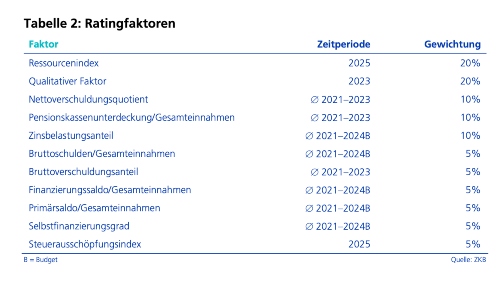
The qualitative factor includes elements not covered by the other ten quantitative criteria, such as contingent liabilities, economic structure, transport infrastructure, and political leadership. It is also the only parameter that incorporates ZKB’s assumptions about the medium- and long-term financial outlook, and is therefore subject to subjective influences.
A Key Debtor Category with Growth Potential
In the Swiss capital market, cantons form an important debtor group. They currently have CHF 29 billion in bonds outstanding—representing around 6 percent of all domestic bonds issued.
A longer-term perspective is also revealing: after bottoming out in 2010, cantonal bond volumes have increased significantly, as many cantons issued debt to cover deficits and restructure pension funds.
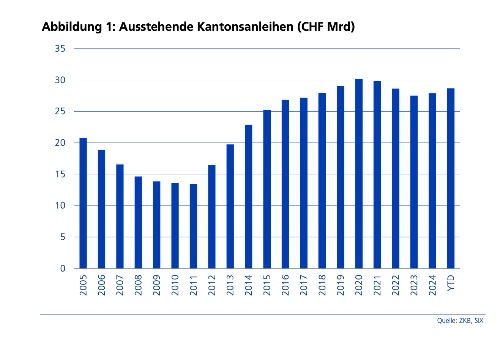
In 2024, the cantons issued 15 bonds totaling CHF 2,5 billion, compared to just CHF 0,8 billion in 2023. Looking ahead, ZKB analyst and report author Carolin Pompetzki notes that relatively few cantonal bonds will mature in 2025. However, she expects the medium- to long-term capital needs to rise, while also highlighting the considerable uncertainties in such forecasts.
«Disruptive Factors» Complicate Forecasts
Tax revenue forecasts are notoriously difficult, and there are also many unknowns on the expenditure side.
One disruptive factor is the profit distribution of the Swiss National Bank (SNB), which depends on the volatile development of global stock and bond markets, exchange rates, and the price of gold. In 2023 and 2024, the cantons received no distributions, but in 2025 they are expected to receive CHF 2 billion (and the federal government CHF 1 billion).
Another uncertainty is the «Relief Package 27» proposed by the Federal Council, which has not yet been passed by Parliament. In its current form, it would likely mean additional costs for the cantons.
Population Growth and Aging Drive Spending
According to Pompetzki, the increasing investments forecast in cantonal financial plans suggest more new bond issues in 2025. In the medium to long term, cantons’ capital needs are likely to keep rising—driven by infrastructure projects linked to population growth and rising healthcare spending due to demographic aging.
The rating revision also affects other government-owned or affiliated debtors. The outlook for AEW Energy (AA–) and Services Industriels de Genève (A+) has been revised to positive. The City of Geneva (AA–) also now has a positive outlook from ZKB.
Hospitals Also in Focus
In the hospital segment, which has come under scrutiny since the GZO Spital Wetzikon case, adjustments have also been made. The rating of Lucerne Cantonal Hospital has been raised from AA– to AA.
For the Cantonal Hospitals of Aarau and Baden (both AA–), at least the outlook has improved.