Clinics & Grand Hotels – The Company That Reimagines Switzerland
Whether enjoying a Michelin-starred lunch at «La Réserve Eden au Lac» in Zurich, spending a winter break at the Alpengold Hotel in Davos – the «Golden Egg» that Intercontinental never quite managed to crack – or going in for a checkup at Privatklinik Bethanien above the Zurichberg: few guests stop to ask who actually owns the place.
That’s a mistake. Behind all of these properties – and many more – stands a publicly listed investment company: Aevis Victoria, based in Fribourg. Outside of French-speaking Switzerland, the name barely registers – a blind spot in public awareness. But in the Romandie, it’s a different story: Antoine Hubert, founder and executive board delegate, and his long-time partner Michel Reybier have been household names for decades. Hubert is also a well-known publisher – he owns 100 percent of the financial daily «L’Agefi».
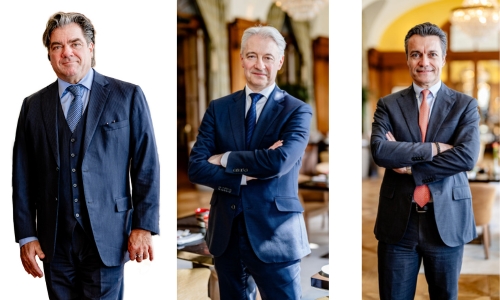
Founder Antoine Hubert, CEO Fabrice Zumbrunnen, CFO Michel Keusch. (Images: Aevis Victoria, Courtesy)
The roots of today’s Aevis Victoria go back more than 20 years. In 2002, Antoine Hubert acquired Clinique de Genolier in the canton of Vaud near Nyon, which became the listed Genolier Swiss Medical Network in 2006. Around the same time, Michel Reybier laid the foundation for his hotel empire by acquiring Hotel La Réserve in Geneva. The two companies merged in 2011.
A Household Name Across Switzerland
Aevis Victoria gained a widely recognized name in May 2024 when Fabrice Zumbrunnen, the former head of Migros, took over as CEO.
finews.com sat down with the company’s three key figures shortly before Easter: founder Antoine Hubert, CEO Fabrice Zumbrunnen, and Michel Keusch, who became CFO in June 2024. The conversation covered share price developments, clinic strategy, luxury hotel brands – as well as linguistic divides and succession planning.
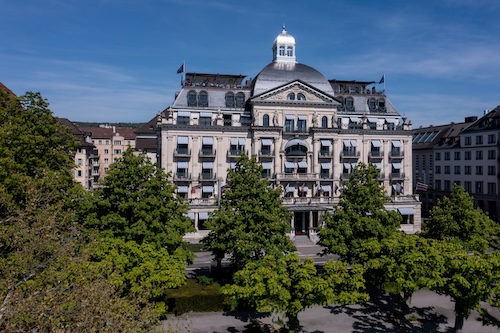
«La Réserve Eden au Lac» in Zurich. (Image: Maud Devaud, Courtesy)
ESG Penalty Out of Nowhere
Recent capital market turmoil set the tone for the interview. Weeks before, even before the so-called «customs hammer» hit, Aevis Victoria’s stock had suffered a sharp drop. More troubling than the volatility itself was the fact that Aevis had been delisted from a SIX ESG index – with no advance warning. «No one informed us, no one could explain why. To this day, we still don’t know,» said Keusch. The result: ESG-focused index funds were forced to sell Aevis shares – «an automated and procyclical process.»
The irony? Aevis Victoria’s businesses are arguably among the least problematic in the index. No coal plants, no mining operations, no questionable supply chains. Instead: Swiss healthcare services, luxury hotels in Interlaken and Zermatt.
50 Percent Discount to Book Value
Keusch said the forced sales are now complete, but the damage remains: «Our discount to net asset value currently stands at 50 percent. It’s never been that high in the company’s history.»
Yet the numbers published shortly after the delisting tell a different story. In 2024, net revenue rose 11 percent to over 1 billion francs, and EBITDA more than doubled. Hotel subsidiary MRH Switzerland grew by more than 10 percent – almost entirely organic – with EBITDA up 46 percent.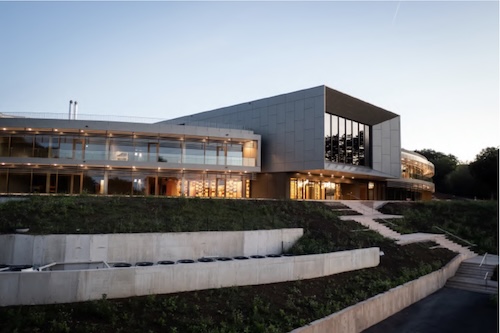
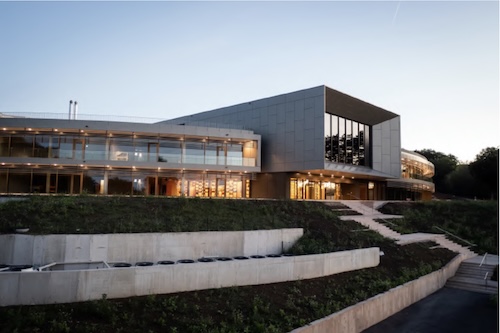
Genolier Hub: Private clinic in Vaud. (Image: Courtesy)
The statutory net profit also swung into positive territory: 26.5 million francs, following a loss the previous year. The group described the start to the current year as «promising».
From Operating Company to Holding Structure
These numbers are no accident. They’re the result of a long-term transformation. As Hubert explained, Aevis has spent several years evolving from an operating company into a holding structure with multiple participations:
«Today, we still hold majority stakes in Swiss Medical Network, Michel Reybier Hospitality Switzerland, and Swiss Hotel Properties. There’s still a lot of development potential in the hotel business.»
He sees the healthcare arm as «relatively mature,» while hospitality remains in an «early phase.» Much of the group’s operational value creation no longer shows up in consolidated results – which explains the growing gap between NAV and market capitalization: «We think long-term. We’re not focused on annual net profit, but on sustainable value creation,» Hubert said.
- Page 1 of 2
- Next >>