
Digital Offerings: Swiss Banks Continue to Fall Behind
Swiss retail banks have continued to lose ground in the global digital ranking. According to the «Digital Banking Maturity» study published by Deloitte on Thursday, they have fallen from 18th place in 2020 and 21st place two years ago to 27th place.
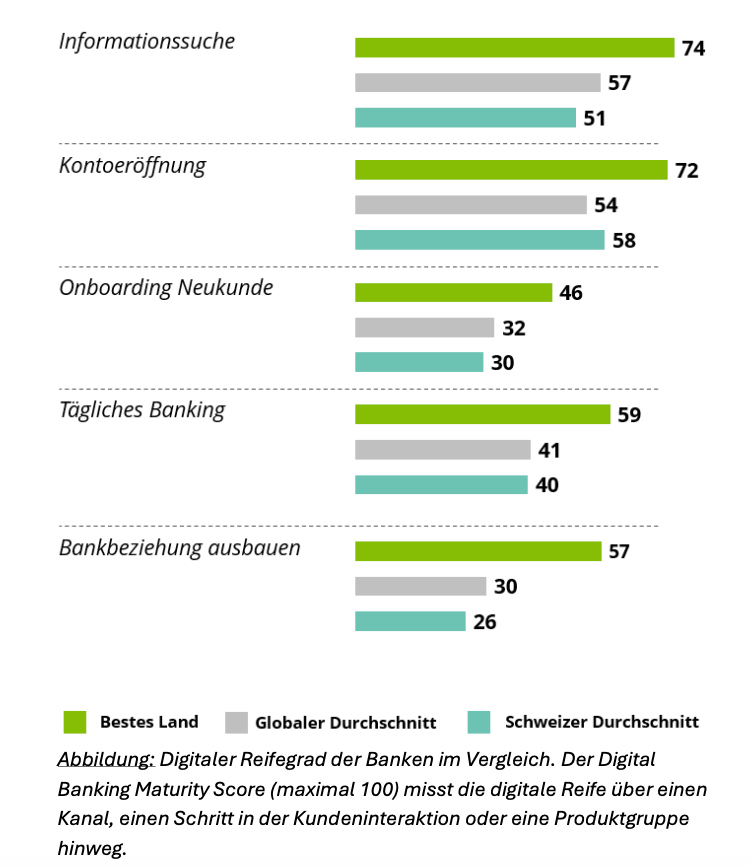
In terms of digital maturity, the 12 Swiss retail banks, which together cover more than 80 percent of the market, achieved a score of only 39. This places them below the global average (41 points) and far behind the digital leaders (60 points or more), according to the report.
Overall, the study analyzed more than 1'000 digital banking functions across 349 banks in 44 countries using a mystery shopping method.
Gaps in Digital Offerings
The authors identify significant gaps in the digital offerings of Swiss banks. «While real-time notifications, AI-powered savings tools, and digital insurance services have long been standard internationally, these services are missing from many Swiss banks.»
Even existing offerings perform poorly in international comparisons. Although Swiss banks have made progress in digital account onboarding, there is still one institution where this is not yet possible.
Processes Are Complicated and Slow
Compared to foreign banks, the process remains relatively complicated and slow. «In countries like the UK, a selfie and an ID scan are sufficient for AI verification and account opening,» says Cyrill Kiefer, Banking Consulting Lead at Deloitte Switzerland.
Furthermore, the smartphone is still not being fully utilized as the primary access channel for banking transactions. Only one-third of Swiss banks offer real-time notifications for expenditures. The situation is even more concerning when it comes to smart savings functions. AI-powered algorithms that adjust savings plans based on individual spending behavior are rarely used.
Added Value Lies in Meeting Customer Needs
Additional gaps in offerings are found in interactive dashboards, customizable budgeting tools, and real-time financial analyses.
Customers of Swiss banks still have to manually manage their expenses or rely on external apps. «The true value of digital banking does not lie in the number of features packed into an app but in how well they meet customer needs at the right moment,» Kiefer emphasizes.
(Graphics: Deloitte)
The leading institutions in digital banking offer value-added services such as public transport tickets, streaming subscriptions, and financial management tools. Among the Swiss banks studied, only one comprehensively integrates insurance services.
Regulations and a conservative strategy are slowing down the development of Swiss banks. As a result, growth potential remains untapped, and customer loyalty is at risk.
«Banks must evolve from mere payment and account management providers into digital service platforms,» warns the Deloitte expert. «Financial management, modern direct payment systems, subscription management, booking systems, and mobility solutions must be seamlessly integrated to become an essential part of customers’ daily digital lives. Those who fail to drive this transformation risk losing an entire generation of customers.»