
Small Retail Banks Are Making a Big Impression
In 2023, Swiss retail banks benefited from increased interest margins, higher profits, and improved efficiency. These findings are highlighted in the «IFZ Retail Banking Study 2024»published by the Lucerne University of Applied Sciences and Arts (HSLU).
The study includes a ranking that evaluates the balance sheets and income statements of retail banks focusing on the Swiss market, using nine key metrics. «Overall, the financial condition of the Swiss retail banks is very good», the authors note.
The rise in interest rates in particular had a very positive impact on the financial statements as at the end of 2023. The interest margin increased from 1.15 percent to 1.31 percent in just one year from an eight-year decline.
Profitability (Return on Assets) increased by 9 basis points to 0.49 percent and the cost/income ratio, which compares operating expenses with operating income, fell by 4.72 percentage points to 52.82 percent.
Small Institutions Ahead
The HSLA ranking is led by small institutions such as Caisse d'Eparnage d'Aubonne, Ersparniskasse Affoltern and Clientis Sparcassa. The best-placed cantonal banks are those from Graubünden, Schaffhausen and Ticino.
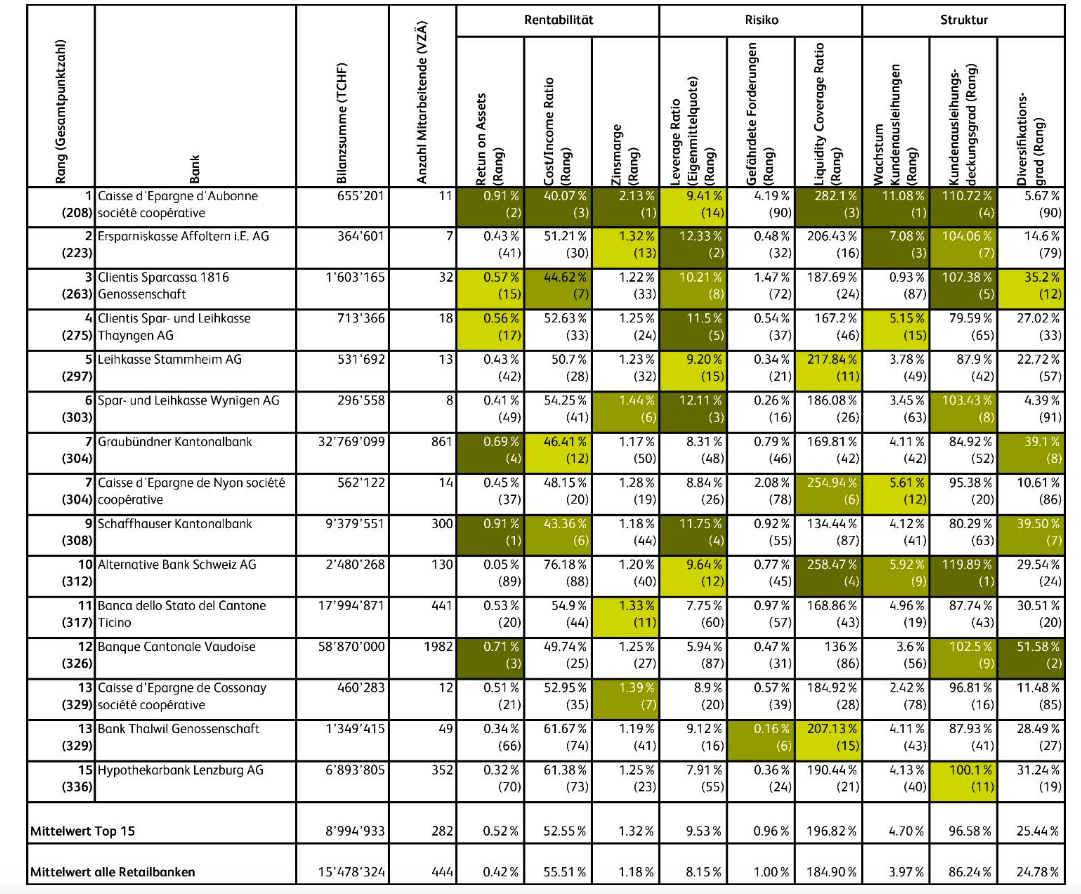
«Among retail banks with total assets of three billion Swiss francs or more, the cantonal banks perform particularly well,» the report continues.
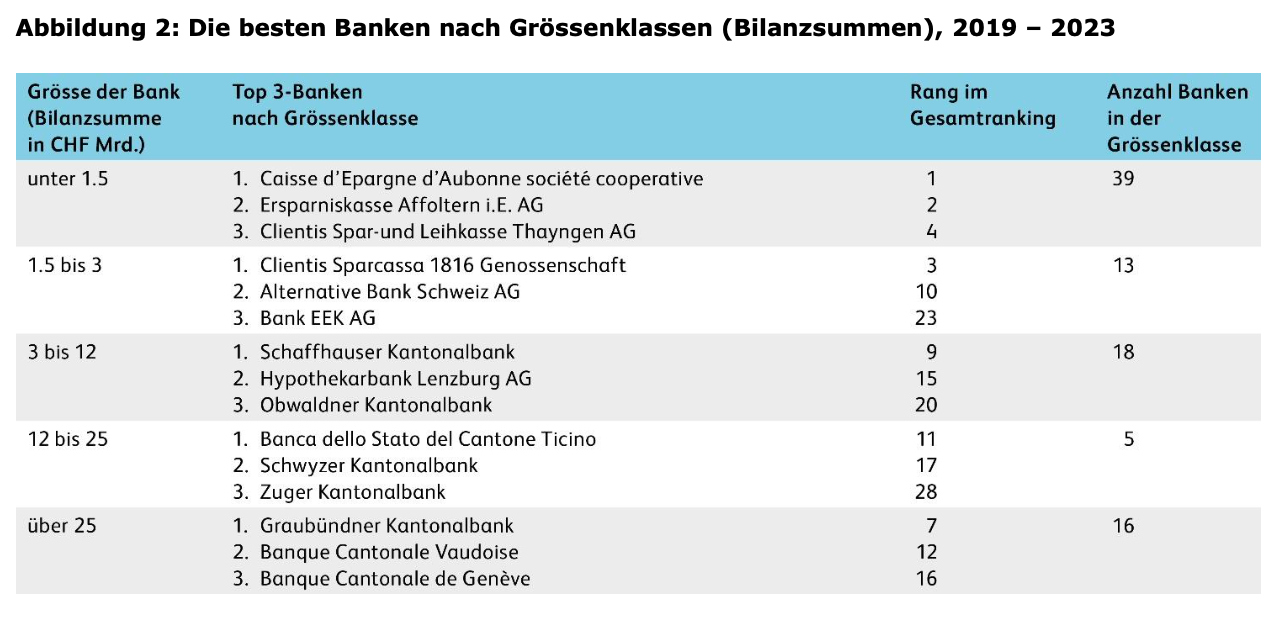
(Graphics: HSLU)
Low Willingness to Switch Mortgages
The HSLU customer survey offers intriguing insights into retail banking. The findings suggest that Swiss customers are notably slow when it comes to comparing mortgage options.
While 86 percent of respondents indicated that a low interest rate is an important factor in choosing a mortgage provider, many still refrain from conducting a comprehensive comparison. For new financing, only one in three customers obtains more than one offer, and for follow-up financing, just one in two does so.
The study's authors attribute this to a «remarkably low willingness to switch». This reluctance is not necessarily due to a lack of awareness. «In many cases, the house bank still enjoys great loyalty, especially if a change involves additional hurdles,» explains Andreas Dietrich. For 30 percent of customers, switching providers is off the table, regardless of the potential savings from lower interest rates.
When Desire Meets Reality
The participants in the study were also asked about their wishes regarding housing and home ownership. Around 40 percent stated that they would like to buy a property. «The desire for home ownership, and in particular for a detached house, remains high,» it says.
The study breaks this down into the groups of potential first-time buyers and those who already own a property but want to make a change. These are referred to as «dreamer» and «second-time buyers».
The Dreamers would mainly include people from generations Y and Z, and a good half of them would primarily be looking for a detached house. They are looking for their first home and have to overcome the associated financial hurdles. The so-called baby boomers are more strongly represented in the second-time buyer group. They are often looking for a new property that better meets their changing needs.
Lack of Equity and Low Income
The biggest hurdles for the majority of Dreamers are a lack of equity and insufficient income. 60 percent of second-time buyers report problems finding a suitable property. «This indicates that current homeowners are often reluctant to sell their property. Not because they don't want to sell, but because they can't find a suitable follow-up solution,» says Dietrich.
Figures from IAZI recently showed how high the financial hurdles now are for first-time buyers. According to these figures, a typical condominium in Zurich (115 square meters) now costs more than 2.1 million francs. Roughly speaking, this would require equity of 400,000 francs and an annual household income of 300,000 francs in order to meet the affordability requirements.