
Glencore: Five Times UBS in Revenue
On Wednesday, mining group Glencore reported revenue of $247.5 billion for 2025 — up 7 percent year-on-year.
Adjusted EBITDA came in at $13.5 billion, down 6 percent, while adjusted EBIT fell 14 percent to $6.0 billion.
Back in the Black
Net income attributable to shareholders returned to positive territory: after a loss of $1.6 billion in 2024, the company reported a profit of $363 million.
Funds from operations declined from $10.5 billion to $8.7 billion.
The UBS Comparison
The second half of the year was significantly stronger than the first: adjusted EBITDA reached $8.1 billion in H2 — 49 percent more than in H1 — supported by higher copper volumes and firmer metal prices.
Although Glencore operates far removed from banking, the sheer scale invites comparison with UBS: while the bank is a global champion in wealth management, Glencore is its industrial counterpart — a company navigating between mines, ships, refineries and industrial clients.
Five Times UBS in Revenue
In pure revenue scale the two companies operate in different spheres. UBS generated roughly $50 billion in 2025 income. Glencore, at around $250 billion, reaches five times that figure — typical for a trading and logistics business moving vast volumes on thin margins.
At operating level Glencore produces substantial earnings: adjusted EBITDA of $13.5 billion is roughly twice UBS’ annual net profit.
EBITDA — the Industrial Result
In mining, EBITDA measures the industrial yield. A resource company invests tens of billions upfront in mines, shafts, processing plants, railways and ports. Once these assets are built, the metric follows a simple principle: tonnes multiplied by margin. EBITDA therefore reflects what the assets generate in a given year, abstracting from the capital-intensive balance sheet.
The much lower net profit instead reflects how capital investments are spread over decades. Glencore depreciates mines and stakes each year, finances large inventories of metals in transit and books taxes. All of this materially reduces cash available to shareholders.
$363 Million Profit
This produces a characteristic pattern of the sector: triple-digit billions in revenue and double-digit billions in operating cash flow can translate into only a few hundred million in reported profit. In 2025 Glencore generated about $13.5 billion of EBITDA but reported only $363 million in net income — a reflection of the industry’s capital intensity.
At the beginning of 2026 the shares gained additional momentum from renewed merger talks with Rio Tinto. The prospect of a mega-group combining iron ore, copper, coal and the world’s largest commodity trading arm proved appealing.
Share Price at an Interim High
The discussions ended on February 5, dampening the development somewhat. Today, however, the shares reacted positively to the results and rose about 3 percent by early afternoon. The market reaction to takeover speculation shows that strategic consolidation is still perceived as the royal road to closing Glencore’s valuation gap.
The failed deal fits a broader pattern: Glencore’s relationship with capital markets resembles more a pragmatic arrangement than a love story. Management regularly complains about the valuation discount relative to peers.
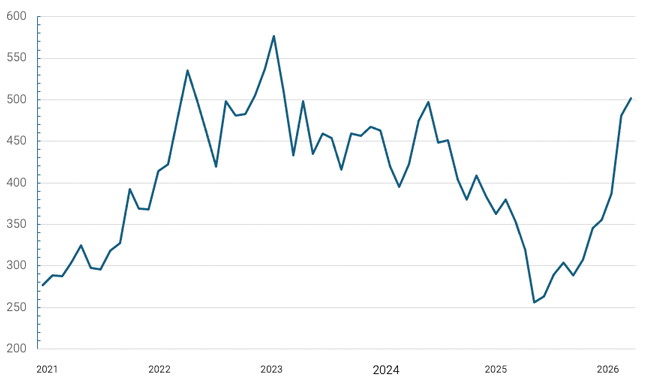
Glencore share price over the past five years (in GBP). (Source: Bloomberg, chart: finews)
Betting on Electrification
Last year the leadership even floated a possible change of primary listing — for instance to the United States — signalling that London does not value the group appropriately.
Strategically, Glencore advances a simple thesis: electrification massively increases copper demand, and few competitors combine a mining portfolio with a global trading network on comparable scale. The company aims for annual copper production exceeding one million tonnes later this decade, largely financed from internal cash generation.
Copper and Coal
At the same time the company, contrary to earlier plans, is deliberately and for the long term staying in coal. It serves as the cash engine financing energy-transition metals — a pragmatic «today finances tomorrow» increasingly defining the group’s identity.
One aspect stands out: historically Glencore preferred brownfield expansions, buying existing mines and optimising them operationally. Now the pipeline includes large greenfield copper projects in Argentina such as Agua Rica and El Pachón.
Multi-Billion Investments in Argentina
These projects require multi-billion investment and long development timelines — something Glencore once avoided. The strategic shift suggests management considers the coming copper shortage structurally significant enough to accept geological, construction and political risks.
No bank embodies Switzerland’s global wealth-management role quite like UBS. Glencore fulfils a similar function for the real economy: the Baar-based company organises the flows of metals and energy on which industry and modern life depend.
Central Role in Global Supply Chains
Recent share gains have somewhat improved Glencore’s standing with capital markets. Nevertheless, the commodity group is still partly valued like a volatile cyclical stock.
The company’s central position in global industrial supply chains and its strong market position in copper are often overlooked.