
Hyundai: Growing Against Europe’s Auto Downturn
Europe’s automotive market struggled last year and has entered 2026 under strained conditions. Demand remains weak, regulation is tightening, and several large manufacturers are being forced into strategic corrections.
Recent developments illustrate how difficult the environment has become. Only last week, Stellantis — the merger of Fiat-Chrysler and PSA Peugeot-Citroën — announced multi-billion-euro writedowns, revised its electric-vehicle ambitions and warned of sustained margin and dividend pressure. At the same time, the Volkswagen Group is grappling with cost overruns, declining profitability and the need for deeper restructuring across its brand portfolio.
An Exception in a Difficult Market
Counterexamples to this trend are rare. Ferrari remains one, albeit outside the logic of industrial mass manufacturing.
Another company, however, has managed to escape the broader industry malaise: Hyundai Motor Company. The group employs more than 8,000 people in Europe, operates significant local production and continues to gain market share.
Hyundai’s share price recently climbed to multi-year highs. The move is largely driven by investor expectations surrounding the company’s growing use of Nvidia’s AI computing platforms for autonomous driving, in-vehicle software and robotics — reinforcing a market narrative that increasingly links Hyundai to the AI supply chain rather than purely to automotive cycles. Solid operating performance across Europe and other key markets supports that view.
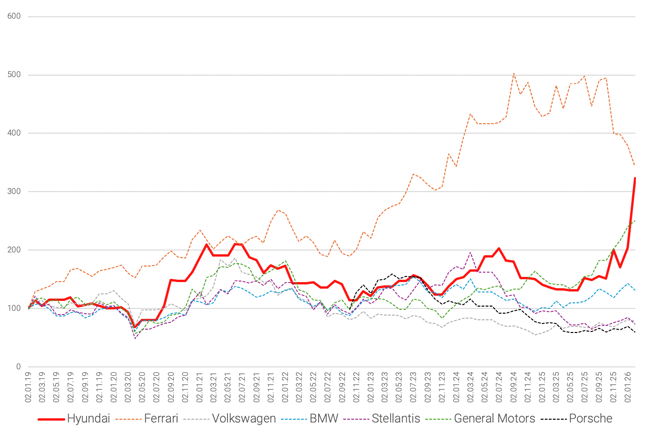
Automakers’ share prices indexed to a common base (USD). (Source: Bloomberg, Chart: finews)
Number 7 in Switzerland
finews attended Hyundai’s European media conference in Frankfurt. There, CEO Xavier Martinet and Genesis Europe chief Peter Kronschnabl outlined a strategy based on execution, a genuinely European footprint, model renewal and expansion, and flexible platforms prioritizing hybrids while retaining electric-only and combustion options.
Switzerland offers a clear illustration. While the overall market stagnated, Hyundai increased registrations from 8,452 vehicles in 2023 to 8,859 in 2024 and 9,374 in 2025. The brand thus reached seventh place in passenger-car registrations with roughly a 4 percent market share.
4.2 Percent Market Share in Europe
The Swiss development reflects a broader European pattern. In 2025, Hyundai registered 603,542 passenger cars across the EU35, corresponding to a 4.2 percent market share. Volumes grew about 1 percent year over year — modest in absolute terms, yet notable in a market where many competitors declined.
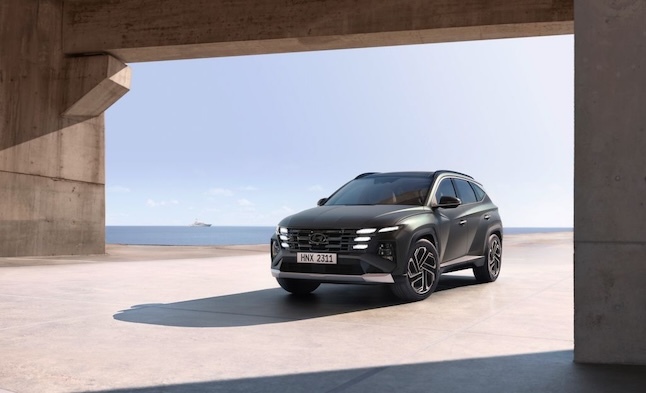
The Tucson accounts for nearly 30 percent of Hyundai’s European sales. (Image: Hyundai Europe)
Europe is also a production base. Hyundai operates two core plants: Nošovice in the Czech Republic, where more than €2 billion has been invested since 2008 and the five-millionth vehicle was built in 2025, and İzmit in Turkey, the company’s first intercontinental plant, which received more than €250 million in investment last year.
Production Anchored in the Region
Together, the sites form the industrial backbone of Hyundai’s European presence and supply a significant share of regional sales.
Hyundai’s European performance also rests on global scale. Hyundai Motor Company sits at the center of a three-brand automotive group — Hyundai, Kia and Genesis — collectively the world’s third-largest car manufacturer. Beyond vehicles, the group belongs to the wider Hyundai conglomerate spanning components, steel, logistics, construction and heavy industry.
Europe as a Long-Term Industrial Region
This structure provides stability. Vertical integration and capital depth allow Hyundai to absorb regional volatility without abrupt strategy shifts. The company treats its European industrial presence as permanent.
In the near term, Hyundai focuses on product cadence. Five new volume models will be launched within 18 months, targeting core European segments.
Milan as a Signal
The Tucson alone exceeded 167,000 European sales in 2025, around 28 percent of regional volume. Newer models such as Inster and the Ioniq range illustrate how carefully positioned products can capture limited opportunities. The upcoming Ioniq 3 is scheduled for presentation at Milan Design Week.
Hyundai does not deny the growing influence of Chinese manufacturers. Martinet described current competition as the toughest in years. The company does not intend to engage in a price war with new entrants, instead relying on positioning and local production.
A European Carmaker?
As European manufacturers increasingly seek regulatory protection against Chinese competition, Hyundai argues it should itself be treated as a European producer. With plants in the Czech Republic and Turkey — linked to the EU via customs agreements — the company believes it meets the criteria policymakers aim to enforce.
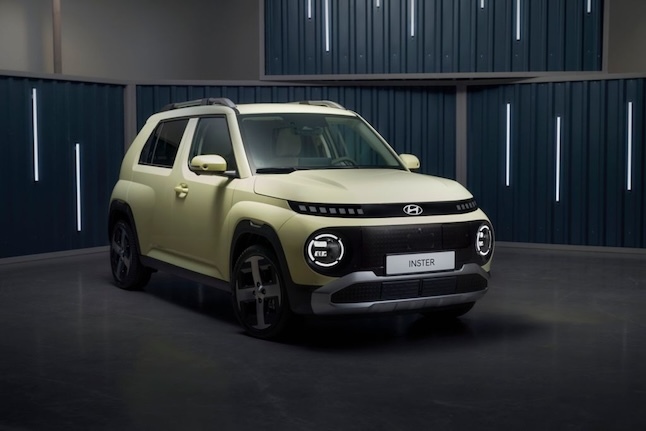
Hyundai’s entry-level electric model, the Inster, was named «2025 Supermini of the Year» by TopGear.com. (Image: Hyundai Europe)
Genesis entered Europe selectively in 2021, beginning with Switzerland, Germany and the UK, expanding to Italy in early 2026 and now France with locations in Paris and Lille.
Genesis’ Premium Strategy
The brand is recalibrating. The exclusive flagship-studio concept is being complemented by integration with Hyundai retail structures, while the initial BEV-only positioning is being softened. The aim is sustained credibility in the premium segment.
finews also discussed Switzerland with Martinet and Kronschnabl.
Switzerland as a Validation Market
For Martinet, Switzerland is less a volume market than a validation market: demanding but attractive, with high transaction prices and customers who reward consistency over discounting.
Recent signals are encouraging. Registrations are rising and dealer sentiment is positive. «We are very happy with how the business is developing in Switzerland,» Martinet said, stressing the importance of strong partnerships — including local importer Astara: «If we and they are happy, customers will be happy.»
Genesis on Bahnhofstrasse
Kronschnabl described Switzerland as a reference market for the broader rollout. The Zurich Bahnhofstrasse studio holds a central role within the European presence.
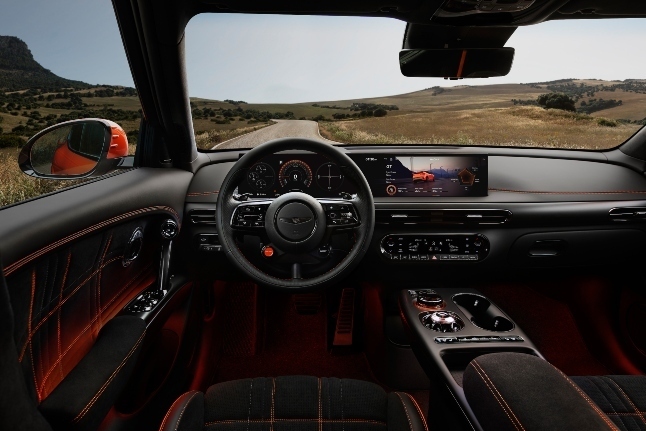
Racing spirit: the cockpit of the recently unveiled Genesis GV60 Magma. (Image: Genesis)
Its position is not in question. «Bahnhofstrasse is very important for us — and it will remain,» he said. What is evolving is its role: from a Swiss showcase into a pan-European flagship communication location.
Revisiting Assumptions
The adjustment forms part of a broader recalibration. Kronschnabl described the early European years as a start-up phase in which not all assumptions proved durable. The brand is now integrating more closely into Hyundai’s retail and service network.
For Martinet, Hyundai’s success ultimately also reflects governance. The group is still led by the founder’s son and operates with two planning horizons.
Two Time Horizons
Alongside short-term operational discipline, decisions are made with a five-to-ten-year perspective. The path from the first vehicle in 1975 to becoming the world’s third-largest manufacturer in 2025 was shaped by choices «not made for short-term results, but for what would be right for the company in five to ten years.»
In an industry dominated by immediate performance targets, Martinet sees this as a structural advantage.