
Where Pension Funds and Companies Feel the Pinch After the Demise of Credit Suisse
What impact has the disappearance of Credit Suisse (CS) had on the Swiss market for banking services? This question has been raised many times, particularly with concern for the corporate banking business, which is central to Switzerland's SME landscape.
On Thursday, the State Secretariat for Economic Affairs (Seco) published a commissioned study («Financial services in Switzerland after the disappearance of Credit Suisse») on this topic (together with five additional studies addressing other aspects of competition). The findings are based on a survey of companies, pension funds and banks active in Switzerland; expert interviews were conducted to provide further depth.
No Widespread Emergency, But Specific Deficits
The reassuring conclusion: the exit of CS has not led to widespread problems across most banking services. However, there are clearly challenges in certain areas.
From the perspective of pension funds, availability in the area of global custody of securities as a custodian bank has decreased. Companies, meanwhile, report deficits in larger corporate loans, syndicated financing and, in some cases, in the Swiss-franc bond issuance business. The main points of criticism relate to availability and pricing, not to the quality of services.
A General Trend Towards Lower Risk Appetite Also Plays a Role
Discussions with experts indicate that the exit of CS has left gaps to this day, particularly in complex financing structures. Demand for such financing comes primarily from internationally active and innovative mid-sized companies, rather than SMEs or global corporations. However, experts assume that these gaps in lending are also linked to the fact that many financial institutions have reduced their risk appetite (a development unrelated to the fall of CS).
Who can replace CS? Unsurprisingly, companies and pension funds view UBS as the alternative most likely to take over the market shares of the defunct major bank in these areas. The picture is more mixed when it comes to cantonal banks and foreign banks.
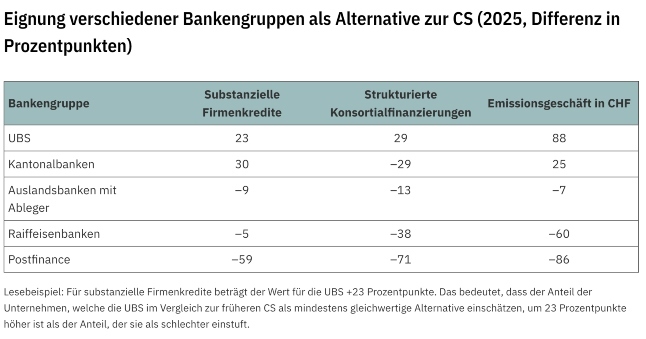
(Table: BAK Economics/ «Die Volkswirtschaft»)
The authors of the study, Claude Maurer (chief economist of BAK Economics for just over a year, previously an economist at CS for almost two decades), Rafaela Schinner and Philipp Christen, note that this finding is supported by the survey of banks.
Cantonal banks are indeed present in the corporate lending and syndicated financing business, but they rarely assume the role of leader or main risk bearer. Their presence in global custody is described as marginal. Why are cantonal banks not more active? They themselves cite strategic considerations, high entry costs and the required know-how. According to experts, political mandates from their owners (the cantons), the strong position in the «business of secured lending» (mortgage business), and in some cases insufficient balance-sheet size also have a dampening effect.
Foreign Banks with Limited Potential
The picture is somewhat different for foreign banks. They explain their reluctance with internal priorities and the strong position of established providers.«Even a withdrawal by UBS would hardly lead to broader engagement,» the study states bluntly. According to experts, foreign banks focus on niches and also lack sufficient Swiss-franc deposits. The strong position of cantonal banks makes market entry more difficult.
Those who wish to delve a little deeper into this issue, which is fundamental for the Swiss banking centre, but do not have the time to read the study in full, are recommended to read the article «CS is gone – who will step in? in «Die Volkswirtschaft».