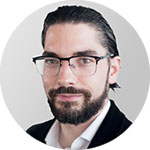
Felix Niederer: «True Wealth Targets Sevenfold Growth»
True Wealth has grown for the tenth year in a row and has now reached profitability for the first time. In an interview with finews.com, CEO Felix Niederer speaks about strong inflows, negative churn rates, a Swiss market in transition, and how much technological renewal behind the scenes is required for a digital wealth manager to remain competitive.
Mr. Niederer, a year ago True Wealth managed 1.6 billion francs in client assets. How did 2025 develop?
We are now at around 2.3 billion francs, managed for just under 40,000 clients. The year developed very positively; we continued to grow strongly, similar to previous years.
Again around 35 to 40 percent growth.
Yes. In 2025 it was more than 35 percent, closer to 40 percent. At this level, that is very pleasing. And importantly, we can now demonstrate that our business model also works economically. In the last quarter, we were cash-flow positive for the first time. Of course, that always depends somewhat on marketing spend or investments, but we have now reached the point where fees cover our fixed costs.
In other words: even with extremely low management fees, the organization now carries itself.
Exactly. Our fee is 0.5 percent up to 500,000 francs, and above that it becomes even lower. That is very tightly calculated, but we have reached the necessary scale. And that puts us in a very comfortable position.
So the proof of concept has definitively been delivered?
Absolutely. That makes me very happy, because many people have worked toward this for ten years. And the nice thing is that we continue to grow strongly, even though we operate with a marketing budget of less than 1 million francs. We could do much more, but growth works even with limited resources.
«We are not seeking investors actively. But we are open to conversations.»
Your growth rates have been very stable. Where does this constant momentum come from?
We have an embedded growth component. Most clients contribute continuously, not just once at the beginning. We analyze our cohorts every quarter, going back ten years. And we see that contributions from existing clients more than compensate for those who withdraw money or leave. In business terms, we have a negative churn rate. As a result, our business would continue to grow meaningfully even if we stopped acquiring new clients and markets did not move at all.
That is a clear advantage compared with many other business models.
Yes. Many companies have to spend a lot of money on acquisition, and once customers leave, revenues collapse. For us, it is the opposite. That is a strong sign that clients are satisfied with our product—even though there is still much we want to improve.
A lot has happened in the market for digital wealth managers. Some competitors are highly visible with expensive marketing. Has competition intensified?
In theory, it should have intensified. There are other digital players, and two of them are doing a very good job. But what is interesting is this: even after ten years, banks are still not digitally dominant. The real competition comes from digital providers like us, and we do not see any negative effect in our numbers—client acquisition has not become more difficult.
Why not?
The Swiss market is sluggish. Many people do not actively consolidate their finances. And the majority of the market is still with expensive, weakly digitalized offerings. I would say there is comfortably room in this market for three strong digital players.
«Our focus is clearly on B2C.»
Has client price sensitivity increased?
In certain segments, clearly yes. Ten years ago, most people had hardly any alternatives unless they had substantial wealth. Today it is different: clients have choices and compare much more actively.
You have maintained white-label partnerships with three banks for years: Erste Bank in Austria, as well as BLKB and Regiobank Solothurn in Switzerland. How is the B2B side developing?
These partnerships continue, but we are not actively expanding them. Our focus is clearly on B2C. When we talk about client numbers or assets under management, we mean our own.
If another bank approached you, would you consider it?
We are not actively seeking it. It is a different business, and our strength clearly lies in translating the scaling advantages of technology into better outcomes for end clients.
The investment strategy you implement for clients remains passive?
Yes. We invest in ETFs and index funds across all liquid asset classes: equities, bonds, commodities, and real estate equities. The providers are the usual ones—Vanguard, UBS, iShares, and others.
«Our market continues to grow strongly.»
Who decides which instruments are included?
Our portfolio management team, which I lead. Because we use only index instruments, the process is simpler than with active managers. Still, we conduct very thorough due diligence. We examine costs, tax efficiency from a Swiss investor’s perspective, and structure—for example, whether an instrument engages in securities lending, and if so, how it is collateralized.
And active management?
That is not a topic for us. Active investing is difficult for private investors, but also for professionals. Identifying good managers is almost as challenging as doing stock picking yourself. In addition, many providers only show products that have performed well. This survivorship bias makes comparisons difficult. And even when the data is available, past performance remains a poor indicator of future performance.
At the same time, efficient markets require active investors.
Of course. But only a very small number of them—and they need to be exceptionally skilled and well capitalized. That is not our field.
You are growing by 300 to 400 million francs in net new assets per year, while many Swiss private banks stagnate at inflows of 1 to 1.5 percent. How do you explain the difference?
Our market is 100 percent Switzerland. We do not feel any structural crisis. Private banks, by contrast, come from a period in which discretion—supported by banking secrecy—was the key selling point. Today, the regulatory environment is completely different. Cross-border business is heavily restricted, which makes the traditional model difficult.
«Financial literacy today is significantly higher than twenty years ago.»
Have you analyzed the new market access agreement with the UK?
It is on our radar, but we have not yet examined it in detail. Switzerland still offers significant potential, and our market continues to grow strongly. According to the Swiss National Bank, households in Switzerland hold around 5 trillion francs in assets—one-third in real estate, one-third in bankable assets, and one-third in pension and retirement assets. Wealth management, pillar 3a, and vested benefits are growing at around 7 percent or more annually. And we see a clear shift away from cash solutions and insurance products toward investment solutions.
Is that a positive development?
Yes. Of course, it is positive for providers like us, but also for clients. Financial literacy today is significantly higher than twenty years ago. Many people have understood that long-term wealth accumulation requires investing. Leaving a larger sum on a bank account for fifteen years achieves nothing.
You began developing your robo-advisor platform twelve years ago. How modern is it today?
We continuously reinvent ourselves. If we had left the product unchanged from ten years ago, we would no longer exist. At one point, we even migrated the entire backend to a new technology stack. That was a year of work invisible to the end client. Today, our stack is very modern.
You operate fully in the cloud?
Yes. Our solution runs entirely in the cloud, primarily on Google Cloud with data stored in Swiss data centers. Starting development when cloud technology was just emerging was a stroke of luck—we never had to operate our own servers, which would have added a complex additional layer.
Do you use AI?
In a broader sense, True Wealth is a form of AI, but our algorithms are deterministic. We do not use black boxes. We must understand exactly what an algorithm does—anything else would be problematic. A major area is automated risk management: rebalancing, exposure limits for individual stocks such as Nvidia or Nestlé, as well as sector and regional limits. The system identifies deviations and brings portfolios back to their target allocation.
«Our algorithms are deterministic.»
What is the next big thing?
We comment only on what has been delivered. But this much can be said: the vested benefits offering will be launched next year. That is a clear client demand.
And beyond that?
We focus on operational excellence and client acquisition. Our goal is to grow another six- to sevenfold over the next five years.
Are you seeking investors to accelerate growth?
Not actively. But we are open to conversations.
Felix Niederer is co-founder and CEO of True Wealth, a Swiss online wealth manager founded in 2013. He holds a master’s degree in physics from ETH Zurich. He then worked primarily in the financial industry, spending four years at Swiss Re specializing in portfolio management and risk modeling. Later, he served as a portfolio manager for quantitative strategies at LGT Capital Management.