
Swiss CFOs Have Recovered from Tariff Shock
The sentiment among Swiss CFOs has improved after hitting a low following U.S. President Donald Trump's tariff announcement in early April. Geopolitical risks, trade conflicts, and currency risks currently top the list of CFO concerns for this half-year, according to consulting firm Deloitte in its study published on Wednesday.
A total of 37 percent of the 119 Swiss financial executives surveyed expect the economy to develop negatively or even very negatively over the next 12 months. Only 24 percent are positive or very positive.
Expectations for Corporate Performance
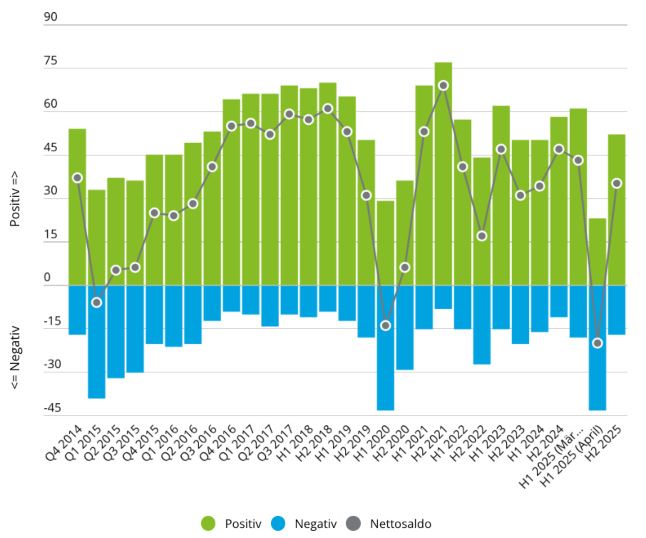
Share and net balance of CFOs assessing their company’s financial outlook for the next 12 months as positive/negative. (Graphic: Deloitte)
In an international comparison, Switzerland ranks in the middle. Although it has the highest proportion of optimists among the surveyed countries over a five-year horizon, it also shows the second-highest proportion of pessimists.
In contrast to the negative economic outlook, corporate expectations remain largely optimistic. Although expectations have declined, they are still clearly in positive territory. Profit margin expectations remain slightly positive, even though sales price adjustments are creating pressure.
Geopolitical challenges continue to top the list of concerns among the surveyed CFOs, the report states. They are followed by trade conflicts and currency risks, both of which have gained significantly in importance. The weaker U.S. dollar against the Swiss franc is making export conditions even more difficult.
Negative Outlook for Employment
This also affects personnel planning, Deloitte writes. More than one-third of CFOs (37 percent) expect their company to cut jobs in Switzerland over the next twelve months. At the same time, a similar share (35 percent) expects staff numbers abroad to increase.
Tariff Reliefs, Free Trade Agreements, and EU Treaties
The survey also asked which measures Switzerland should take in response, from the CFOs’ perspective. At the top of the list are tariff reliefs in U.S. trade and additional free trade agreements (both 55 percent), followed by the conclusion of new EU treaties (51 percent).
Corporate reactions mostly include price adjustments, cost reductions, personnel measures, and production relocations abroad. Many companies also view the crisis as an opportunity to invest in technology and new business areas.