
Testarossa Returns: Ferrari’s 1,050-Horsepower Statement
finews.com was on site on Tuesday, September 9, in the city of Milan, where the covers came off the new 849 Testarossa. Chief Designer Flavio Manzoni explained the choice of venue by pointing to Milan’s status as «capital of design.» He linked the sculptural body to architecture – explicitly citing Oscar Niemeyer’s Mondadori headquarters – to frame a car conceived as rolling architecture.
Sharing the stage were Enrico Galliera (Chief Marketing & Commercial Officer) and, crucially, Gianmaria Fulgenzi (Chief Product Development Officer). Galliera stressed that, as with every Ferrari outside the limited Icona series, the brief was modernity and technical excellence, while Fulgenzi underlined that the project rejects a «nostalgic» approach – this is a forward-looking racer for the road.
Name, Positioning and Heritage
The name «849» nods to the eight cylinders and 449 ccm displacement per cylinder, while «Testarossa» revives a label historically reserved for Ferrari’s most potent core-range cars – a reference that originally described the red cam covers of Maranello’s racing engines and later anointed the 1984 icon. The newcomer formally replaces the SF90 in Ferrari’s range, becoming the performance benchmark of the regular lineup.
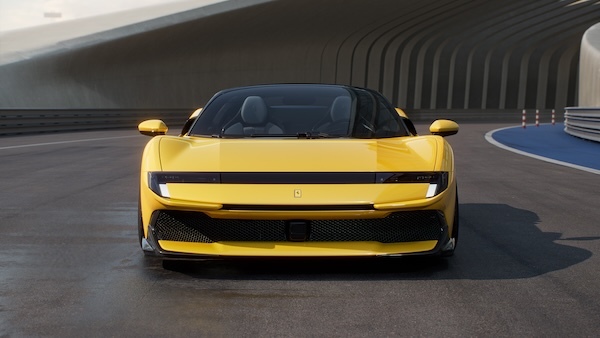
Spider version of the new 849 Testarossa. (Image: Courtesy)
Ferrari says total system output now reaches 1,050 cv, 50 cv more than the SF90. The PHEV layout remains familiar: a mid-rear twin-turbo V8 and three electric motors (two up front for e-4WD and torque vectoring, one on the rear axle), with the electric side delivering 220 cv.
What’s New Under the Skin
The big hardware story is the V8: still 3,990 cc, but now at 830 cv (equals 819 hp) and 842 Nm at 6,500 rpm – up 50 cv over the previous iteration used in SF90-era cars. Ferrari achieved this with a completely re-worked unit: an all-new, larger turbocharger (the biggest ever on a production Ferrari), revised cylinder heads and block, new exhaust manifolds and intake plenums, titanium fasteners, and updated fuel system.
For context, the first SF90 launched in 2019 paired its hybrid system with a V8 rated at 780 cv (769 hp) and 800 Nm at 6,000 rpm – the ICE gains here are real, not rhetorical.
Aerodynamics, Cooling – and Those Wild Doors
Form follows function throughout. Total downforce is 415 kg at 250 km/h – a 25 kg increase versus SF90 – while overall cooling performance rises by 15 percent. Packaging the bigger turbo and the need for more flow are written spectacularly into the body: the deeply sculpted doors double as aerodynamic ducts, increasing intercooler airflow by 30 percent and feeding brakes and engine intake via a multi-inlet side intake. Underneath, new front underfloor vortex generators lift the front’s share of downforce and cut drag.
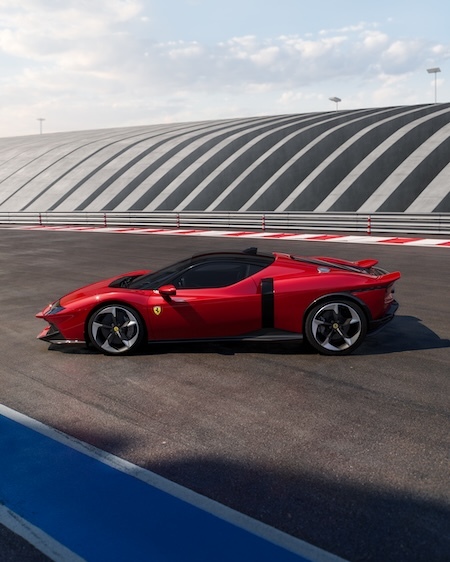
Muscular design signature: twin-tail rear sections, inspired by the 1970 Ferrari 512 S. (Image: Courtesy)
At the rear, a twin-tail architecture inspired by the 512 S works with an active spoiler (now 2 kg lighter) that flips between Low-Drag and High-Downforce in under a second, contributing up to 100 kg of load at 250 km/h. A multi-level diffuser and re-engineered rear underbody maintain load while trimming drag by 10 percent versus the SF90. Braking-air management is overhauled front and rear to cope with higher loads.
Electronics to Make You Faster: FIVE & ABS Evo
The new FIVE (Ferrari Integrated Vehicle Estimator) runs a real-time digital twin of the car using an onboard 6D sensor. It estimates non-measurable dynamics like vehicle speed (±1 km/h) and yaw angle (±1°) and feeds all the major controllers – e-4WD, e-Diff, traction control – for more precise, repeatable responses. «It lets a skilled driver drive like a professional on the track,» as Galliera put it.
Working with FIVE is ABS Evo, now active in all Manettino positions. Later, harder, more repeatable braking is the result, supported by larger discs/pads and optimised ventilation channels. The quoted stopping distance is 28.5 m from 100–0 km/h (and 108.0 m from 200–0 km/h), a figure Ferrari representatives framed as roughly a six-percent gain over SF90: «In racing, this changes a lot,» Galliera said.
Numbers That Matter
Ferrari claims 0–100 km/h in <2.3 s, 0–200 km/h in 6.35 s and >330 km/h top speed. On Ferrari’s home benchmark – the Fiorano lap – the 849 Testarossa stops the clock at 1’ 17’’ 500, which is 1.2 seconds quicker than SF90 according to officials in Milan.
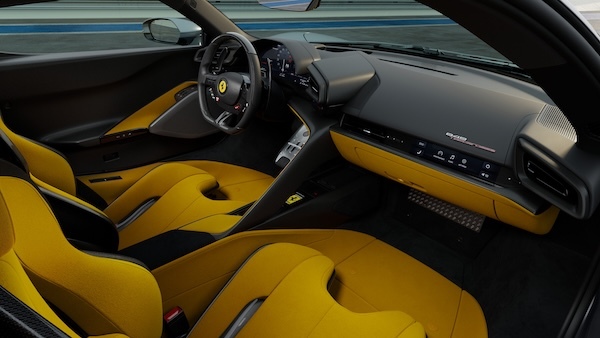
Interior in Giallo Siena Alcantara. (Image: Courtesy)
Despite beefier hardware that would have added more than 20 kg, the 849 Testarossa keeps the SF90’s 1,570 kg dry weight thanks to meticulous light-weighting (including titanium fasteners and lighter valve gear), yielding the best power-to-weight of any Ferrari range model to date.
Design, HMI and Cabin
Manzoni’s team pushes a more architectural language: vertical and transverse volumes, the 1970s sports-prototype vibe and that dramatic twin-tail. Inside, a horizontal dashboard with a floating upper, «C»-shaped vents and an F80-inspired gate on the central «sail» create a cockpit that is both sculptural and functional. A new steering wheel re-introduces mechanical buttons (including the iconic Engine Start), with the digital cluster managing the e-Manettino’s four modes. Wireless phone charging, Apple CarPlay/Android Auto and the MyFerrari Connect app come standard.
Seats come in comfort or carbon-fibre «racing» spec; ergonomics and ingress are improved by slimmer lower door structures. New colours debut – Rosso Fiammante and Giallo Ambra – plus a Giallo Siena Alcantara for the interior.
Assetto Fiorano: The Track-Lean Option
The optional Assetto Fiorano spec trims about 30 kg with composites and titanium, adds 20-inch carbon-fibre wheels and stiffer single-rate Multimatic dampers. Aero changes include larger front flicks and an extra pair of underfloor vortex generators; at the rear, twin wings replace the twin tails, tripling vertical downforce without a major drag penalty. For the first time, a front lifter can be paired with Assetto Fiorano by keeping semi-active Magneride. A dedicated gradient-stripe livery (Bianco Cervino or Rosso Corsa) completes the look.
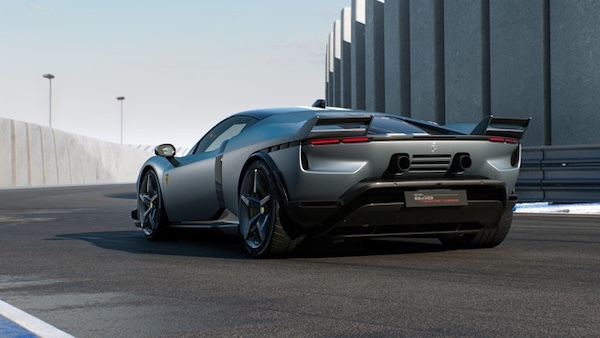
«Assetto Fiorano»-augmented version of the car. (Image: Courtesy)
As with other modern Ferraris, the 849 includes seven years’ scheduled maintenance worldwide. Hybrid-component coverage is five years, with factory programs that can extend the warranty to year eight (including a no-cost HV battery replacement at that point) and even out to year 16 under «Power Hybrid».
Market View: Switzerland and Beyond
Since 2021, 255 SF90s have found Swiss homes – roughly 10 percent of the country’s 2,377 Ferrari registrations – an impressive share given the SF90’s price bracket. Asked about the new 849’s geographic sweet spots, Galliera said racing affinity and driving skill today are spread evenly worldwide, making the sales outlook broad-based.
As a regular-range Ferrari, the 849 Testarossa can be ordered by any client through a dealer – but production will be constrained by capacity. «It will be certainly lower than what we could theoretically sell in the market,» Galliera told us. Italian drive-away pricing was announced at 460,000 euros for the berlinetta and 500,000 euros for the spider; the Assetto Fiorano package adds 42,400 euros to either. That represents a moderate rise versus SF90 launch prices (which were 430k euros for the coupe and 473k euros for the Spider). Swiss pricing will follow in the coming weeks and could prove relatively milder after currency moves.