
Former Swiss Private Banker Proposes Bold UBS Breakup
He hardly speaks publicly any more, given the fact that he has handed over the private bank he founded to his son and also because of his advanced age. But when it somes to UBS's «too big to fail» (TBTF) problem, Karl Reichmuth cannot and will not remain silent.
With the takeover of Credit Suisse (CS), the major Swiss bank has once again gained significantly in weight and, as a systematically relevant giant, benefits from a de facto stateguarantee and therefore an implicit subsidy in the eyes of many economists. To mitigate this problem and reduce the risk that UBS will one day have to be bailed out by the state in a crisis, the Federal Council wants to increase capital requirements in particular as part of the tightening of TBTF legislation.
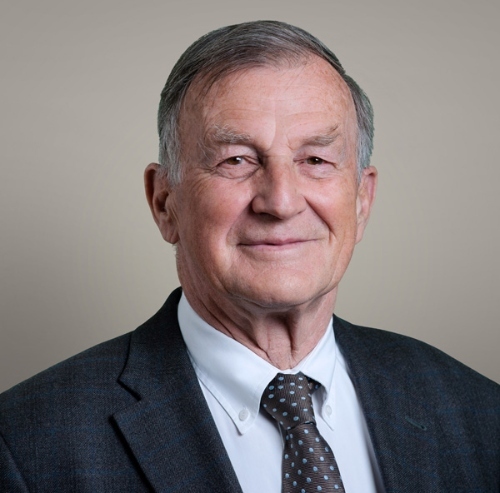
«I am concerned about foreign influence, which can ultimately undermine our national sovereignty.» (Image: zVg)
Reichmuth, speaking as a member of a group with other well-known personalities from the world of finance (who do not wish to be named), has a different suggestion.
Mr. Reichmuth, in what way is UBS a problem for Switzerland?
Because its size means it enjoys a de facto state guarantee and every Swiss taxpayer stands surety for it. As our country is relatively small, the saying «Bürgen tut würgen» takes on a special meaning.
«The saying ‹Bürgen tut würgen› takes on a special meaning due to the size of UBS in relation to Switzerland.»
As a former private banker who was fully liable for his bank, aren't you perhaps a little biased on this issue?
I am speaking here first and foremost as a citizen. It bothers me when those responsible are not liable for their decisions. I am concerned about the huge risk for the taxpayer. And also about the associated foreign influence, which could ultimately undermine our national sovereignty, especially as a significant proportion of the bank's equity is held outside Switzerland. But I believe that UBS is fundamentally well positioned today in the Board of Directors and the Executive Board and would like its value-creating activities to remain in Switzerland.
What are the arguments against the Federal Council's approach of more equity capital?
Excessively high capital requirements also have disadvantages for a globally active and therefore internationally competitive institution. UBS is trying to ensure that the public understands the advantages and disadvantages of more equity capital. But it should also make more of its own proposals to minimize risk and explain to taxpayers what it is guaranteeing.
What do you suggest?
That UBS should make its capital-intensive investment banking independent and domicile it where the best conditions and culture exist, for example in London or New York. This is why Anglo-American banks are generally better positioned in this area. Investment banking - done well - is much more profitable than the usual deposit and lending business. In wealth management, on the other hand, UBS is the second largest player after Blackrock. Here it benefits from Switzerland's reputation, particularly in terms of reliability.
How will this separation work in practice?
Together with a few friends, we let UBS know that a share split could be one of the best options. You could proceed in the same way as Holcim recently did with Amrize. Instead of the US business, however, the investment banking business would now be spun off. UBS shareholders could decide whether they also want to become owners of the new investment bank in London or not.
«Most of the capital market specialists and key personnel for UBS Investment Banking are already based in London.»
Wouldn't that lead to a drain of know-how and corresponding qualified personnel in Switzerland?
No. In my experience, for example with the IPO of Emmi, most of the capital market specialists and key personnel for UBS's investment banking are already based in London. It goes without saying that Swiss clients with a Swiss booking office have access to these specialists in London.
Wouldn't the relocation of Investment banking also lead to tax losses in Switzerland?
Yes, that would be a negative side effect, especially for Zurich as a business location. However, if politicians impose excessively strict capital adequacy rules on UBS, making it no longer competitive, tax revenues will also decrease, perhaps even more significantly.
The idea of separating high-risk investment banking has already been considered in the past by Swiss and other major European banks, but was always rejected in the end, mainly because they wanted to continue to offer «everything from a single source». Doesn't this argument also apply to UBS?
This is a question of structure and organization, which is the responsibility of the bank's Board of Directors. However, as mentioned, the problem with UBS is so serious that this proposal must at least be examined very seriously. And this admittedly drastic step could also create the conditions for reining in political forces and regulation in the financial sector. This would allow us to move more in the direction of a free market economy with the principle of «decision and liability belong together», to the benefit of individuals and the Swiss people.
Karl Reichmuth (born in 1939) founded the private bank Reichmuth & Co in Lucerne in 1996 and is now its Honorary Chairman. He is also the father of Realunit, a tangible asset investment designed to preserve the purchasing power of money, and founded an independent investment company for this purpose in 2001. He began his career in 1958 at Schweizerische Kreditanstalt, where he worked in Geneva, London, New York and Chiasso. He then spent around ten years on the Executive Board of Luzerner Kantonalbank. However, Reichmuth's very first job, as he revealed to finews.ch, was as a cheesemaker for family reasons.