
Swiss Economy Braces for Rough Weather
Swiss businesses are looking to the future with less confidence. The Business Climate Index for the third quarter has dropped by 18 percent compared to the previous quarter. These are the findings of the latest Global Business Optimism Insights Report, published Wednesday by Dun & Bradstreet (D&B). Switzerland is faring worse than most other countries, as global economic optimism has declined by “only” 6 percent. Only France and Brazil reported a stronger drop in optimism.
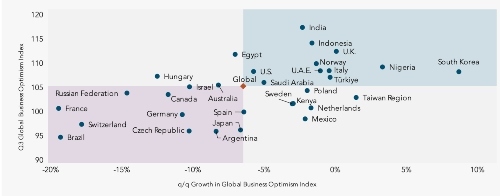
Swiss companies assess the outlook with above-average pessimism (Graphic: D&B)
The report surveys business expectations quarterly from 10'000 companies across 17 industries in 32 countries. It comprises five Global Business Indices: the Optimism Index, the Supply Chain Continuity Index, the Financial Confidence Index, the Investment Confidence Index, and the ESG Index. The first four reflect expectations for the upcoming quarter (in this case, Q3), while the ESG Index reflects sentiment regarding sustainability topics in the current quarter (Q2).
The statistics are based on surveys and D&B's economic database. A score above 100 indicates improvement compared to the base year, while a score below indicates deterioration.
Supply Chains as the Main Concern
Confidence in financial stability in Switzerland declined by 12 percent (compared to –3 percent globally), and the Supply Chain Continuity Index fell by 20 percent (global: –10 percent).
Switzerland remains relatively stable in terms of ESG engagement. While the global index stagnated, the domestic drop was limited to 4 percent.
Growing Uncertainty Felt
Marianne Bregenzer, Country Lead Switzerland at D&B, commented:
«Global risks, new regulations, and economic policy uncertainties are causing noticeably cautious sentiment—even in Switzerland. The drop in the supply chain continuity index highlights the growing challenges: weak growth, looming trade conflicts, and the EU’s CO₂ border adjustment mechanism (CBAM) are increasingly unsettling companies.»
The findings contrast with other observers’ assessments, which suggest that Swiss companies are less affected by trade and geopolitical tensions than their foreign counterparts.