
Mysterious Boom: Record Number of Private Bankers in Switzerland
Last week, KPMG Switzerland published the latest edition of its «Clarity on Swiss Private Banking» study, which was also presented on finews.ch.
One striking finding: While the number of private banks has roughly halved since 2010, the banks included in the study employed more people than ever in 2024 — a total of 40,464 full-time equivalents (FTEs).
Record employment?
The study is based on data from annual reports and covers a large portion of Swiss private banks, with the notable exception of UBS, which was not included for methodological reasons.
However, the study’s market coverage (the number of private banks considered as a share of the total) has varied over the years. It was therefore initially unclear whether this really represented a historic employment record.
Average FTE growth...
finews.com asked Christian Hintermann, banking expert at KPMG Switzerland and author of the study, to take a closer look at the data. The result: «On average, Swiss private banks employ more staff today than in the past,» says Hintermann, illustrating the trend as follows.
| 2017 | 2020 | 2024 | |
| # FTEs | 30,715 | 37,969 | 40,464 |
| # Banks in study | 85 | 83 | 71 |
| # Banks in industry | 107 | 92 | 85 |
| Market coverage | 79% | 90% | 84% |
Especially for the period from 2020 to 2024, it can be concluded that the total number of employees at private banks has likely increased significantly: Even though the study’s market coverage dropped from 90 percent to 84 percent, the banks included employed 6.6 percent more staff than in 2020.
... and in total
According to KPMG, no additional large bank was included between 2020 and 2024 that would have significantly skewed this finding. (By contrast, the figures for 2016 and 2020 are less comparable, as several larger private banks became subject to public reporting requirements due to conversions into joint-stock companies, and thus entered the sample in 2020 but not yet in 2017.)
A look at the aggregated assets under management (AuM) of all banks included in the study shows: In 2017, these amounted to 2.6 trillion francs, in 2020 to 2.9 trillion, and in 2024 to 3.4 trillion francs.
Growth in average AuM per bank
Average AuM per bank also increased from 35.5 billion francs in 2020 to 47.2 billion francs in 2024, reflecting both higher managed volumes and ongoing market consolidation.
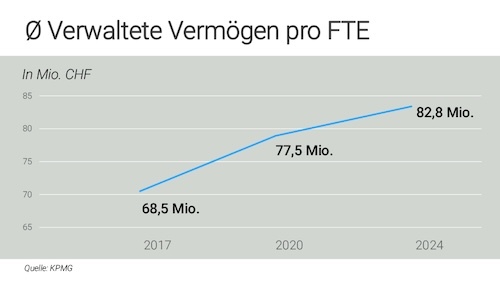
AuM per employee developed as follows:
(Graphic: finews.ch)
This raises the question: Was the increase in FTEs between 2020 and 2024 mainly due to regulatory factors, or was it rather driven by front-office roles?
Primarily driven by relationship managers
While stricter regulatory requirements did contribute to job growth, Hintermann says the main reason lies «primarily in the hiring of relationship managers to stimulate organic growth, as well as in expanding service offerings — for example, by building asset management expertise in private markets.»
Thomas Bossard, founding partner of Stellar Executive Search, confirmed this analysis to finews.com. «At private banks, with their strong client focus, we observe targeted hiring. Not broad-based, but clearly focused on roles with strategic leverage and direct business impact,» Bossard says.
«Tangible impact»
Relationship managers with an entrepreneurial mindset and access to high-growth segments such as business-owner families, the next generation, or international client clusters are particularly sought after. «The market is looking not just for technical competence, but for tangible impact,» Bossard adds.
At the same time, demand is also rising for expertise in private markets strategies and governance-relevant functions such as compliance or risk management.
Similar dynamics among EAMs
The independent asset manager (EAM) market is seeing similar trends. Stellar Executive Search recently published a corresponding market analysis showing that around 1,000 specialized client advisors will be missing in the coming years (finews.com previously reported).
The dynamic here is similar to that among banks: «The number of firms is tending to decline, while larger EAMs are advancing in organizational depth, operational maturity, and personnel strength. FTE growth is targeted — above all in key roles such as relationship managers, COO functions, and investment specialists.»
Positive outlook
For relationship managers in wealth management, the career outlook remains positive according to Bossard: «The role is evolving significantly. Demand is no longer just for sales strength, but also for digital fluency, multi-generational communication skills, and strategic thinking.» Demographic shifts further intensify the need for talent.
Bottom line: The job market for client advisors remains attractive — even if uncertainties exist at UBS and Julius Baer due to restructuring. Prospects for talent with an entrepreneurial mindset and access to wealthy clients remain promising.