
How Central Bank Expectations Have Shifted
UBS conducts an annual survey among central banks to assess their outlook on the economic environment. The results provide insights into potential shifts in investment, currency, and reserve policies.
One central theme of the survey was the prospect of a second presidency for Donald Trump. His tariff policies and «MAGA» plans aimed at boosting the U.S. economy are met with deep skepticism.
More Pessimistic Than in Mid-2024
According to UBS’s «Annual Reserve Manager Survey,» pessimism about economic prospects has increased noticeably. Nearly 40 percent of respondents now expect either stagflation—low growth and high inflation—or a soft landing with a return to moderate growth and inflation over the next five years. In contrast, around 66 percent had expected the latter scenario just a year ago, while only 18 percent foresaw stagflation.
Expectations regarding inflation and interest rates have also deteriorated. Forty percent of respondents believe the U.S. Consumer Price Index inflation will range between 3 and 4 percent within the next year, while 54 percent expect it to be between 2 and 3 percent. Over 80 percent anticipate that the Federal Reserve’s key interest rate will fall between 3 and 4 percent in a year’s time.
Trade Conflict Escalation Now a Major Concern
There has also been a clear shift in perceived risk areas. The potential escalation of trade conflicts has emerged as the top concern, cited by 74 percent of respondents—making it the most frequently mentioned risk. It has overtaken global geopolitical tensions, such as the military conflicts in Ukraine and the Middle East, which were cited by 51 percent.
The risk of a global recession is also viewed as significantly higher, with 31 percent of responses compared to 13 percent the previous year.
Low Confidence in the MAGA Strategy
There is little confidence in President Trump’s MAGA policies as a means of stimulating economic growth. These include tariff measures, deregulation, tax cuts, lower energy prices, and government agency cutbacks (DOGE). A striking 86 percent of those surveyed expect this strategy to fail and believe Trump will not be able to sustainably invigorate the U.S. economy.
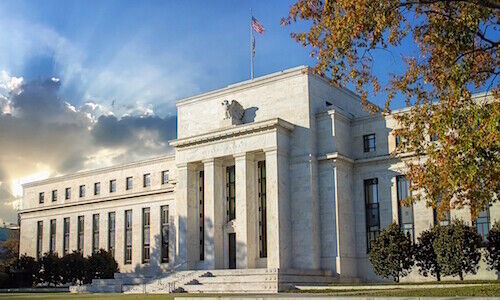
Federal Reserve in Washington DC. (Image: Shutterstock)
Respondents also expressed concern that the new administration’s policies could jeopardize the U.S.’s unique status and the dollar’s position as a preferred investment destination. For instance, 65 percent of central bank managers believe the independence of the Federal Reserve is at risk, while 47 percent foresee a deterioration in the rule of law. This could significantly influence asset allocation decisions. Additionally, 29 percent see a threat to the openness of U.S. capital markets.
Moreover, 47 percent expect the quality of U.S. economic data to decline, and nearly 50 percent consider a restructuring of U.S. debt to be a possible scenario in the future.
Tariffs Seen as Manageable
Regarding tariff policies, survey participants are cautiously optimistic. They expect the impact on trade and international alliances to be relatively limited. Most believe that tariffs will eventually be negotiated to a level manageable for the global economy. An overwhelming 91 percent expect that trade relations between the U.S. and China will continue.
In terms of asset allocation, central bank reserve managers still see strong arguments for diversification. However, the trend appears to have reached its peak, according to the survey authors.
Gold remains in high demand and is expected to deliver the highest risk-adjusted returns over the next five years. Emerging market bonds, corporate bonds, and especially green bonds are also frequently mentioned as assets central banks intend to add in the coming year. At the same time, the trend toward greater equity allocation is slowing.
The dollar is no longer the sole measure of all things. (Image: Pixabay)
The Dollar Remains the Dominant Reserve Currency — For Now
Almost 80 percent of respondents believe the U.S. dollar will remain the world’s dominant reserve currency in the coming years. However, there are clear signs of diversification into other currencies, with the euro likely to benefit most. Sentiment towards the renminbi also appears to be slightly improving.
Digital assets, including cryptocurrencies and stablecoins, are also cited as one of the asset classes expected to benefit most from the current geopolitical environment.