
Raiffeisen: GDP Growth Remains Dependent on Immigration
Weakened expectations for the global economy — particularly in the U.S. and EU — are also weighing on the outlook for Switzerland. Trade relations with the U.S., Switzerland’s second-largest trading partner, continue to face significant risks, fueling persistent uncertainty for exporters, write Raiffeisen’s economists.
Negotiations are progressing slowly, and U.S. tariffs on Switzerland’s pharmaceutical sector — so far exempt — remain a real possibility. «We expect a higher average tariff rate,» said Chief Economist Fredy Hasenmaile during a web call on Tuesday. «The market underestimates that Trump is focused on increasing tariff revenues, not on reciprocal tariffs.»
«Even if President Trump’s tariff offensive ends up being less severe than feared, the uncertainty is paralyzing the industry, and the economy will lose momentum in the second half of the year,» he added.
Drop After Frontloading Effects
Pre-emptive purchases and uncertainty took a toll in the first half of the year, as reflected in Swiss economic activity. After a strong first-quarter boost from frontloading effects, there was a sharp downturn — with activity dropping to its lowest level in 15 months.
For the current and upcoming year, Raiffeisen’s economists now forecast GDP growth of 1,1 percent and 1,0 percent, respectively. In December 2024, a growth rate of 1,3 percent had still been expected for 2025.
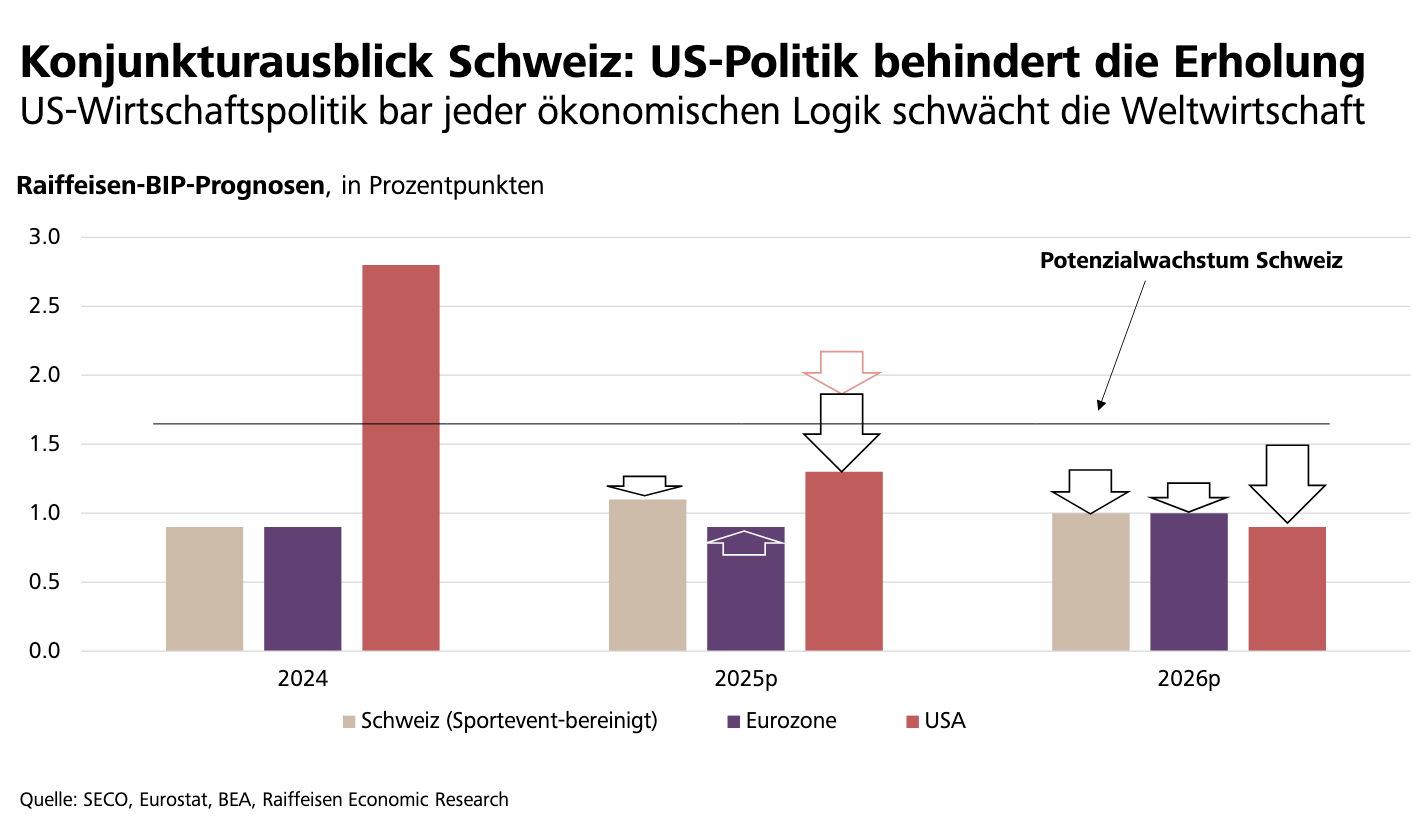
«The return to potential growth of around 1,5 percent is further delayed,» Hasenmaile explained. With this outlook, Raiffeisen positions itself at the lower end of the forecast spectrum, adopting a conservative stance.
Weak Industrial Outlook, Mixed Sectoral Signals
Industrial companies, based on purchasing manager indices, report poor business conditions. In contrast, domestically focused SMEs are performing better and are on a growth path. Export-oriented firms are seeing declining demand, particularly from Germany, with only around 20 percent expecting improvement.
The service sector had shown positive momentum for about 10 months but has now slipped below the 50-point growth threshold in the PMI.
Real Wage Growth Supports Consumption
Swiss consumer spending is buoyed by wage increases and low inflation. This has led to real wage growth, which is supporting purchasing power. However, the labor market is showing signs of cooling.
Slower Employment Growth
These mixed expectations are reflected in the labor market. The KOF employment indicator has weakened, and surveys show declining hiring intentions. This signals slowing employment growth and a seasonally adjusted rise in unemployment.
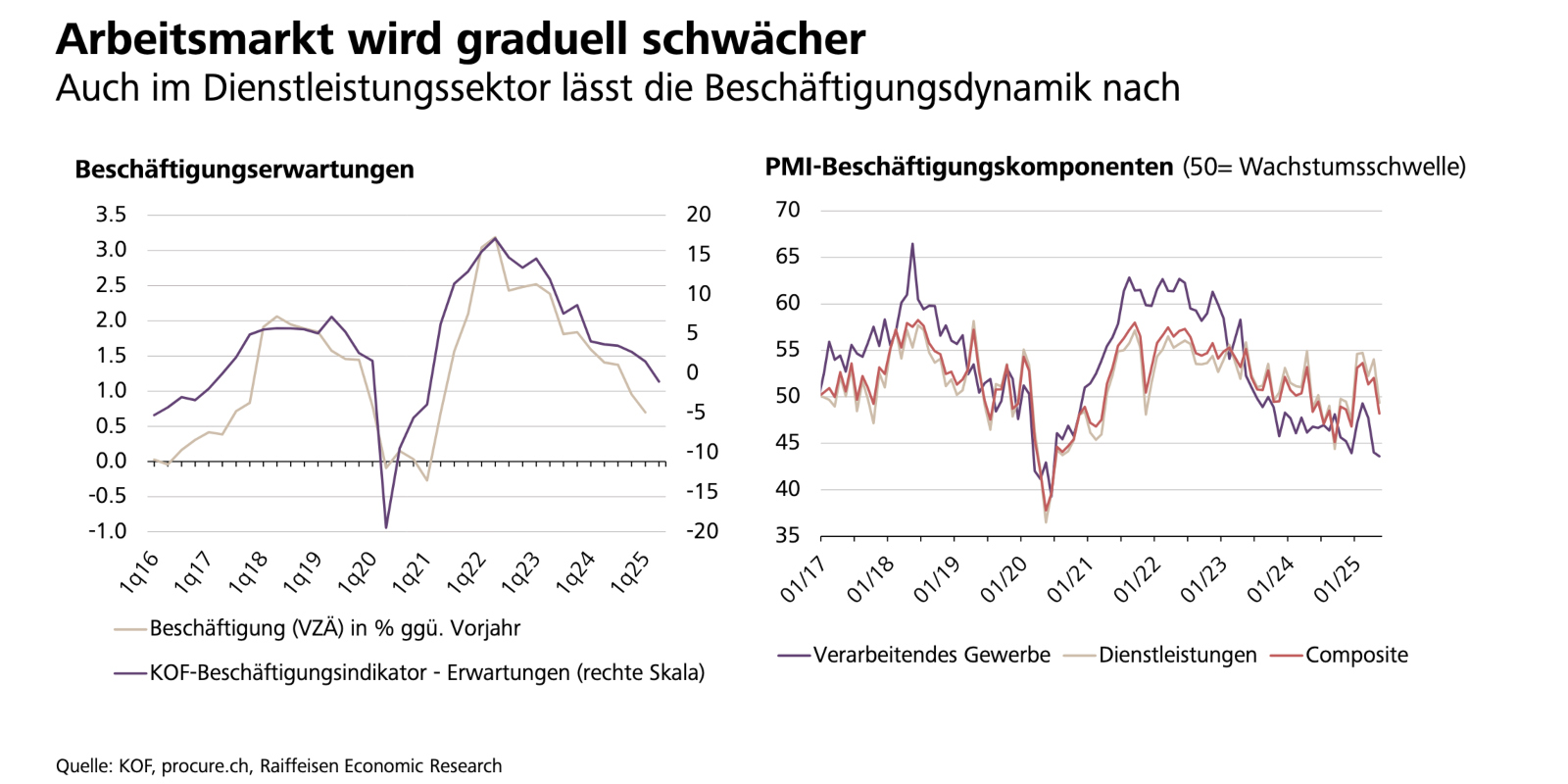
«So far, the industrial downturn has hardly affected the service sector,» noted Hasenmaile. «But even the previously resilient domestic market could face challenges later in the year.»
Negative Rates Unlikely in Switzerland
Overall, the tariff dispute is seen as a major barrier to Switzerland’s return to potential growth. «The tariff issue remains the elephant in the room.»
Regarding Swiss National Bank (SNB) interest rates, Hasenmaile commented: «Zero is not negative.» He does not expect the SNB to push rates into negative territory again. «That’s a much higher hurdle — more would be needed.»
More Leeway for Rate Cuts Abroad
The strong Swiss franc influences interest rate policy. The dollar’s weakness has helped the euro.
Further rate cuts are expected in the eurozone and the U.S., where there is still some room to maneuver. However, Hasenmaile expects the European Central Bank to hold rates steady in July.
Per Capita Economic Output Falls
Two more years of only moderate growth would mean that Switzerland’s per capita economic output will decline again. The country remains in a phase where the economy grows primarily through population growth — that is, merely keeping pace with demographic expansion.
Hasenmaile expects population growth of 0,9 percent for 2025 and 0,8 percent in the following year. «Net immigration depends on the domestic labor market and developments in the EU.»
Regional Disparities
Structural factors and regional disparities also play a role. Raiffeisen economists distinguish between population-driven sectors — such as retail, education, and healthcare — and autonomous sectors like industry, knowledge-based services (e.g., IT), and tourism.
While autonomous sectors are stagnating or shrinking in many regions, others are experiencing strong growth. Zurich, for instance, contributed over 40 percent of autonomous growth, especially through IT and business consulting services. Central Switzerland and parts of western Switzerland — such as Nyon, Rolle–Saint-Prex, and Renens–Ecublens — are also growing dynamically and resisting deindustrialization.
However, the share of growth from autonomous sectors has declined overall.