Wellington's Push Into Swiss Wealth Management
Wellington Management doesn’t have its Swiss office on Bahnhofstrasse, where Zurich's banks display their institutional power. Instead, it’s tucked away on the opposite side of the Limmat River, in the cobblestone lanes of the Niederdorf quarter. Here, where cafés outnumber corner offices and delivery vans replace limousines, you’ll find the European outpost of one of the world’s largest asset managers – overseeing more than $1.3 trillion globally.
The Swiss team is headquartered across the two upper floors of a narrow townhouse, typical for the area. We’re seated on the top floor, across from Jenö Szabo and Luca Michienzi, under the gentle slope of the roof. Through the old windows, you can see the rooftops and towers of Zurich’s historic center – and while the stately façades of Bahnhofstrasse remain out of sight, you know they’re right across the river.
Ten Nationalities, Ten Languages
Before opening the Zurich office, Wellington had already served Swiss clients – but remotely, from London. That changed in 2013, when Jenö Szabo was brought in to establish a local presence. Since then, the assets managed for Swiss clients has grown fivefold. Szabo, who previously spent 13 years with Capital Group, now leads a multilingual, multi-generational office of 11 people – ten nationalities and ten languages – from this very office
Wellington Switzerland is now at a turning point. The firm recently promoted Luca Michienzi, a CFA and CAIA charterholder with ESG credentials and entrepreneurial experience, to lead its business development efforts in wealth management, alongside Vanessa Dispot in the country.
Push Into Wealth Management
The push into wealth management is strategic, and ambitious.
In a year marked by volatility, geopolitical friction, and cautious investor sentiment, finews.com sat down with Szabo and Michienzi to ask the questions on everyone’s mind – and find out how one of the world’s most global investment houses keeps its balance amid the noise.
Gentlemen, you’ve both seen your fair share of market tension. What makes this current phase different?
Michienzi: I started my apprenticeship in 2008 – at Citibank. When I signed the contract, it was the world’s largest bank by market cap. By the time I started during the global financial crisis sentiment in the financial sector had shifted. That shaped how I see cycles. Today feels different – less panic, more realism.
Szabo: For me, the first real shock was 1987. I had just started at Volksbank – it doesn’t exist anymore – and like every young banker, I wanted to show my parents I knew the importance of investing beyond savings accounts. That was a few weeks before the crash. Since then, I’ve been through the dot-com bust, the GFC, and Covid. You learn to stay calm. Markets don’t stay frozen forever.
«Think of it as a large ecosystem of boutiques.»
And what’s the mood at Wellington internally?
Michienzi: Our focus on the long term means we can look beyond the volatility following «Liberation Day»... There’s no CIO, no house view – so every PM has to own their decisions. But they collaborate. I was just on the road with one of our senior global equity PMs. What he said stuck with me: «Stick to your process. Stick to your philosophy.» That’s exactly the tone right now.
Szabo: Clients aren’t panicking either. They’re asking questions, yes – but they’re informed, focused. We’re proactive in how wereach out to our clients. And when you’ve been through this a few times, you know: the world finds a way out.
Founded in 1928, Wellington Management today runs over $1.3 trillion in assets for more than 3,000 clients across 60 countries. Despite its size, the firm operates in an unusually decentralized way: there is no global CIO, no unified investment opinion, and no pressure for its portfolio managers to align under one corporate view.
Instead, Wellington is structured more like a federation of small, autonomous investment teams — a design that often baffles outsiders. What looks from the outside like a single asset manager is in fact a constellation of over 60 investment boutiques, built organically over decades and supported by a vast, firmwide research infrastructure.
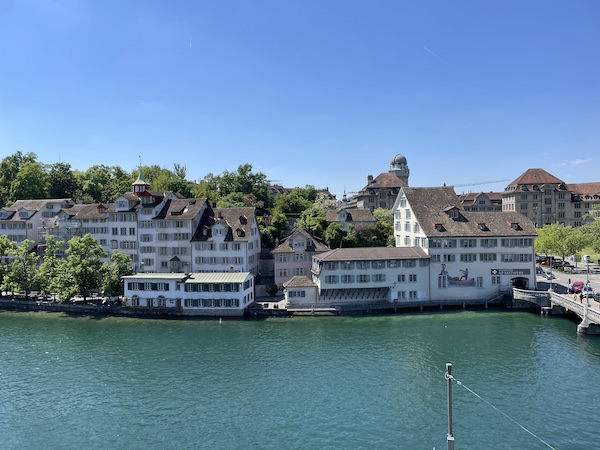
Office With a View. (Image: Courtesy)
Morning Meetings Between Boston, London, and Asia
That research network is the glue. Morning meetings – held simultaneously across Boston, London, and Asia – bring together hundreds of analysts, portfolio managers, and economists daily. At the heart of this system is a belief that conviction doesn’t require consensus.
In Switzerland, that structure is mirrored at a smaller scale. While the Zurich office is a representative office, not a formal investment hub, it houses business developers, relationship managers, and notably, a team of portfolio advisors — investment specialists who engage directly with clients on strategy, market outlook, and product allocation. It’s part of what sets Wellington apart in the Swiss market.
Mr. Szabo, there is no chief investment officer at Wellington. How does that work in practice?
Szabo: Clients are sometimes surprised when we say that. But yes — we really don’t have a CIO. There is no «Wellington house view.» If someone asks what we think of U.S. equities, we say: which portfolio manager are you asking about? We have macro strategists, of course — and they’re excellent — but their views are offered, not imposed. Every investment team owns its decisions.
«And when you’ve been through this a few times, you know: the world finds a way out.»
So Wellington is essentially a collection of different viewpoints?
Szabo: Exactly. Think of it as a large ecosystem of boutiques — each with its own mandate, its own way of working. But all are plugged into a shared research platform.
Michienzi: And that culture creates two things: responsibility and collaboration. Portfolio managers know their decisions are theirs alone — but they also have access to extraordinary shared insight. Our analysts — in credit, equity, ESG — are among the best in the industry. Many of them are partners in the firm, which tells you something.
Do those analysts also manage money?
Michienzi: Many of them do — our analysts are career analysts and many of them are partners of the firm. They’re highly respected, and their research is used across the platform. The idea is that you combine the autonomy of a boutique with the resources of a global asset manager.
Szabo: That’s why we’ve been successful with large institutional clients. They appreciate the depth, the structure, the long-term orientation. It’s not about pushing a product — it’s about building conviction.
Wellington Management’s scale is anything but minor. For decades, the firm has been the largest sub-advisor in the world, with a market share of over 20 percent, managing portfolios for other global players while staying mostly invisible to the end client. Among its longest-standing partnerships is its collaboration with Vanguard, which began over fifty years ago. Wellington remains Vanguard’s largest external active manager relationship today.
Strategic Alliance with Vanguard and Blackstone
In March 2024, the firm was named «Best Asset Manager» in Switzerland at the Morningstar Awards for Investing Excellence. The jury highlighted Wellington’s consistent strength across equity and bond strategies, its collaborative analyst culture, and its thoughtful approach to talent development. The award coincided with the tenth anniversary of the Zurich office and served as a validation of its steady expansion across both institutional and wealth segments.
But the firm’s ambitions go beyond recognition.In April 2025, Wellington announced a new strategic alliance with Vanguard and Blackstone, aiming to develop investment solutions that integrate public and private assets. The alliance reflects a structural shift in how global portfolios are being built — and Wellington’s desire to shape that evolution from the inside.
Where do you see the strongest product demand at the moment — especially among Swiss clients?
Michienzi: It really depends on the segment. In the wealth space, there’s been a strong shift toward quality equities, core strategies, and — recently — renewed interest in fixed income, especially flexible bond mandates. Investors want yield, but they also want active risk management.
What does «flexible» mean in that context?
Michienzi: It means giving the portfolio manager room to move — across interest rate exposures, credit quality, geographies. We have strategies that can shift from Treasuries to high yield if conditions warrant it, or manage duration very actively. That’s become essential in this environment.
And what about hedge funds?
Szabo: Hedge funds have seen a clear comeback — and what we’re seeing now is a real demand for pure alpha. These are strategies with zero beta, market-neutral, designed to generate consistent returns in all environments. They don’t rely on market direction.
«Our analysts — in credit, equity, ESG — are among the best in the industry.»
How is Wellington positioned to deliver that?
Szabo: All of our hedge funds are run in-house, by teams we’ve built over time. There’s no outsourcing. That gives us full control over process, risk, and philosophy. And it also allows us to plug those capabilities directly into client solutions — whether institutional or wealth-focused.
Are those strategies accessible for wealth clients?
Michienzi: Increasingly, yes — after a more muted period we are seeing renewed interest. Wealth management clients have several avenues to invest in these structures. We have noticed that even for institutional-grade alternativesliquidity is essential. That’s a big step in bridging the gap between private banks and alternatives.
Jenö Szabo is Managing Director and Head of Wellington Management Switzerland. He established the Zurich office in 2013 and oversees client relationships across Switzerland, France,and Eastern Europe. Szabo previously spent 13 years at Capital Group and holds an Executive MBA from IMD Lausanne.
Luca Michienzi is Business Development Manager at Wellington Management in Zurich, focusing on the wealth management segment in Switzerland and Liechtenstein. He joined the firm in 2017 after roles at UBS Asset Management and Citibank. Michienzi holds the CFA and CAIA designations.