
Macroeconomic Storm Puts SNB in a Tight Spot
Last Monday, the Federal Statistical Office (BFS) reported a standstill in price trends for the month April. Inflation for consumer goods was 0.0 percent, both compared to the previous month and the previous year.
Economists, who had anticipated a slight uptick, now see increased room for the SNB to cut interest rates further. Still, it's uncertain whether the Governing Board, led by SNB Chairman Martin Schlegel, will lower the key rate from the current 0.25 percent to zero as early as June.
Inflation in Switzerland has been on the decline for months. It has been below 1 percent since September 2024. Currently, this is mainly due to the fall in oil and gas prices as a result of the customs dispute and fears of recession. While goods produced in Switzerland continue to face price increases, the prices of imported goods are falling.
«The latest inflation data clearly show that downside risks for inflation remain elevated,» says Fredy Hasenmaile, Chief Economist at Raiffeisen Switzerland. «The case for further interest rate cuts has strengthened, especially with the expansion of US.. punitive tariffs.»
Lower energy prices in combination with a strong franc could even lead to deflation in Switzerland in the coming months. «We expect a high probability of a further interest rate cut to 0 percent in June,» the economist adds. «Negative interest rates cannot be ruled out in the event of stronger negative customs effects.»
Negative Interest Rates Would Burden Banks
With a view to the Swiss franc, however, Christopher Koslowski, Senior Fixed Income and FX Strategist at Vontobel, sees little scope for interest rate cuts. Negative interest rates are an area that the SNB has only recently left and which it would rather not enter again. «A return to this zone could weigh heavily on bank profitability, unsettle savers and reignite the political debate about broader costs,» he writes in a commentary.
The strong Swiss franc exchange rate against the euro and especially the dollar is being driven by the wave of demand for a «safe haven» that investors are looking for in the face of global market turbulence, says Koslowski. The Swiss currency has risen by more than 10 percent against the dollar this year.
The close integration of the Swiss economy with the EU and the eurozone countries means that the SNB is also keeping a close eye on the ECB's monetary policy. The cycle of interest rate cuts is unlikely to be over yet.
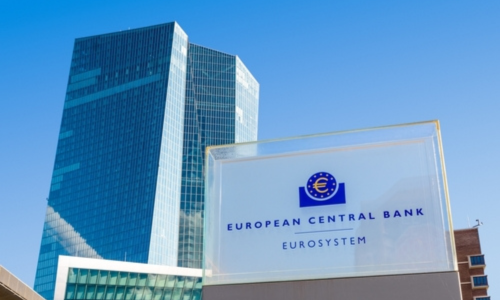
The headquarters of EZB in Frankfurt (Image: Shutterstock)
«The European Central Bank sees the deflation process in Europe on a good course,» Fredy Hasenmaile continues. «Lower energy prices, the weaker economy and any redirection of goods flows due to US tariff policy are likely to have an additional disinflationary effect.»
The tariff shock is likely to weaken growth as well as wage and price pressure in the eurozone. «In our forecast, we expect further interest rate hikes at the next regular meetings and a key interest rate level of 1.5 percent by the end of the year.» The ECB's deposit rate currently stands at 2.25 percent.
Fed Waits and Sees what Happens
Experts were not surprised that the Federal Reserve's Open Market Committee left interest rates unchanged in the range of 4.25 to 4.5 percent last Wednesday. The majority had expected the wait-and-see attitude.
«Due to the higher than expected tariffs, the US Federal Reserve sees both increased downside risks for the economy and hightened upside risks for inflation,» Raiffeisen noted. «This creates a deeper conflict of objectives for monetary policy.»
Despite this, the Fed currently sees no reason to adjust its still-restrective interest rate policy, citing the continued strength of the labor market. «As long as significant uncertainty remains over the direction and impact of U.S. tariff policy, the Fed views a wait-and-see strategy as the most prudent approach.» Raiffeisen economists expect interest rate cuts to resume in the second half of the year, as sign of a slowdown in the U.S. economy are likely to become more evident.
Fed Chairman Jerome Powell expects that the current level of tariffs - if it is maintained as announced - will probably lead to higher inflation, lower growth and higher unemployment.
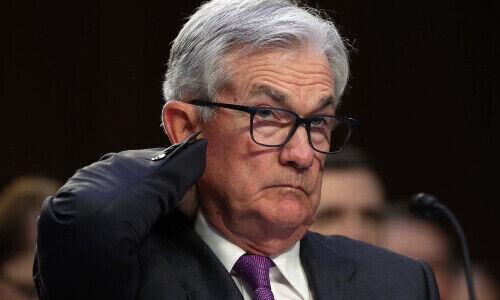
Fed Chairman Jerome Powell. (Image: Shutterstock)
According to DWS economist Christian Scherrmann, two conditions would have to be met before the Fed ends its «hawkish pause». «Firstly, that the tariffs actually have no second-round effect beyond the expected price level shift and secondly, that demand and labor markets weaken sufficiently to formulate disinflationary expectations.»
Powell under Fire
However, interest rates have also taken on a stronger political dimension in the U.S. since Donald Trump took office. His criticism of Jerome Powell, which has gone as fas as contemplating his dismissal, is likely to continue in the coming months.
The Fed must now maintain its independence from the wishes of the White House and continue its wait-and-see approach, while news on customs policy continues to stir up the markets, writes Susan Hill from Federated Hermes, for example.
The ECB will make its next interest rate decision on June 5, the Fed FOMC on June 17/18 and the SNB on June 19.