
These Four Swiss Financial Institutions Are Hotly Tipped
UBS, Partners Group, Swissquote, and St. Galler Kantonalbank (SGKB): These are the top picks for 2025 in the financial sector. This is according to a study on Swiss banks recently published by the equity research team of ZKB, which itself is notably not publicly listed.
At first glance, it may seem surprising that the stocks of four financial institutions with such different business models are recommended as «outperformers.» However, the ZKB analyst team, led by Michael Klien, provides compelling reasons why this quartet has a favorable risk-reward profile and potential for growth.
- UBS: The successful integration of Credit Suisse (CS) has created significant value, which is not yet fully reflected in the share price. However, the current phase is expected to be marked by increased volatility, as the easier gains have largely been realized. Over time, the benefits of the integration should become apparent, making it sensible to remain invested.
- Partners Group: The leading provider of so-called evergreen funds, which make private markets accessible to affluent individuals, operates in a sector expected to grow from $500 billion today to $5 trillion within the next five years. This should allow the company to continue increasing its assets under management by 10 percent annually. In the short term, the normalization of transaction activities, especially in the IPO environment, should provide additional support.
- Swissquote: ZKB predicts a significant increase in market share for the leading online trading platform in Switzerland, from the current 2,5 percent to at least 7,5 percent. Additionally, Swissquote is making inroads in Europe. Consequently, the company is expected to grow its assets under custody by more than 10 percent annually in the foreseeable future. While declining interest rates are weighing on interest income, increased client activity offers potential.
- SGKB: The Eastern Swiss cantonal bank, with its mortgage business, is admittedly impacted by the interest rate trend—the ZKB economists expect the Swiss National Bank (SNB) to lower its key interest rate, and consequently the Swiss franc money market rates referenced by SARON, toward 0 percent. However, much of this headwind is already priced into the stock. The likelihood that the damage will be less severe than the market expects outweighs the risks. Additionally, SGKB, as a diversified bank with solid wealth management and private banking operations, is well-positioned to capitalize on opportunities arising from the transformation of the banking landscape, particularly with the integration of CS.
The ZKB analysts delve extensively into the implications of interest rate developments and Basel III regulations on bank earnings in their study. Due to the heterogeneity of the Swiss financial sector, the impacts vary significantly across institutions.
Lower Interest Rates Affect Not Only Cantonal Banks
If the SNB lowers its key rate further in 2025 as expected, this will primarily impact banks that rely heavily on interest income. Examples include Valiant Bank and the cantonal banks, particularly the Luzerner Kantonalbank. In contrast, companies like Partners Group, Leonteq, or VZ Vermögenszentrum, due to their business models, have minimal exposure to interest rates.
The ZKB analysts outline a hypothetical scenario involving a massive interest rate shock, where the entire yield curve shifts down by 1 percentage point. They then calculate the sensitivity of profits (relative to Tier 1 equity) based on 2023 figures. Unsurprisingly, the results show that the Geneva and Glarus cantonal banks are the most sensitive to such a shock. However, EFG International and Vontobel—where the mortgage business plays a minor role—rank next.
The Complex Interest Rate Effect
The actual impact of lower interest rates on earnings depends on a variety of factors, including how quickly a bank can adjust the interest paid on savings deposits downward and, conversely, how long it can delay adjustments on the active side, such as issuing new mortgages. A high share of outstanding variable-rate mortgages is also negative for banks in a declining interest rate environment.
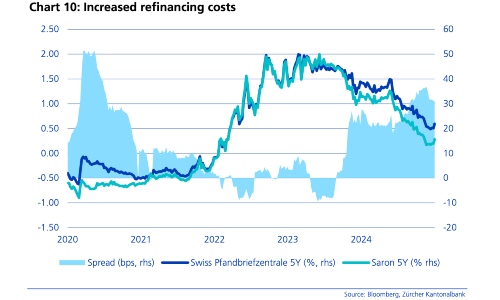
In addition to customer deposits, most banks utilize other financing sources, particularly the bond market. While SNB rate cuts generally lead to downward pressure on yields, banks were paying higher risk premiums (spreads) over the swap market in 2024, which serves as a reference. Here, banks exchange variable for fixed interest rates and vice versa.
Banks Face Higher Spreads in Capital Markets
«Even cantonal banks with very high credit ratings, which previously issued bonds with minimal premiums over SARON, have had to accept spread increases to 40-50 basis points. This trend is evident across the industry and is reflected in the spreads of covered bonds, which are considered virtually risk-free in Switzerland,» observes ZKB (see chart below).
Naturally, this development impacts banks with a larger deposit base less than those relying more on capital market financing—either directly or indirectly through the two covered bond institutions.
Banks holding larger portfolios of variable-rate assets are generally more affected by lower interest rates, according to the study. This also explains the surprisingly high exposure of EFG and Vontobel at first glance.
BCV: A Bank Benefiting from Switzerland's Solo Move on Basel III Final
The capital standards of Basel III Final, which were agreed upon internationally but implemented unilaterally by Switzerland as of January 1, 2025, primarily affect banks that rely on internal ratings to assess the creditworthiness of their clients. One such bank is Banque Cantonale Vaudoise (BCV), which, according to ZKB analysts, may actually benefit from the new regime overall.
What the Super Bowl Has to Do with the «Basel Endgame Rules»
Switzerland's solo implementation of Basel III Final is apparently partly due to the stronger influence of banking lobbies in other countries. ZKB points out that U.S. banks advertised against the regulations—known there as the «Basel Endgame Rules»—during the American Football Super Bowl.
The Swiss Bankers Association (SBVg) has repeatedly expressed concerns about Switzerland's unilateral action. It already opposed a premature move by Switzerland at the end of 2022 and was «irritated» in June 2024 when the Federal Council decided to implement the standards at the beginning of 2025. Perhaps in the future, it will need to run more aggressive campaigns, like the Financial Services Forum in the U.S. with its «Another bill Americans can't afford» campaign.
UBS Capital Debate Is Also Relevant for Other Banks
Back to the study: ZKB also believes that the outcome of the discussions on future capital requirements for UBS will not only be relevant for the major bank but could also have implications for other Swiss banks.
Therefore, any manager of a Swiss (non-major) bank who believes the capital adequacy debate does not concern them (and may even feel a sense of gloating) might soon face a rude awakening.