
Real Estate Prices: A Breather Before the Next Price Surge
The price momentum on the Swiss real estate market stalled in the last quarter of 2024, according to the IAZI report on transaction prices. The willingness to pay for residential property remained unchanged overall, while a slight decline in prices paid on the market was even recorded for investment properties.
However, in view of the favorable framework conditions, above all falling interest rates, this is likely to be only a temporary dip, the report continues.
Decline in Investment Properties
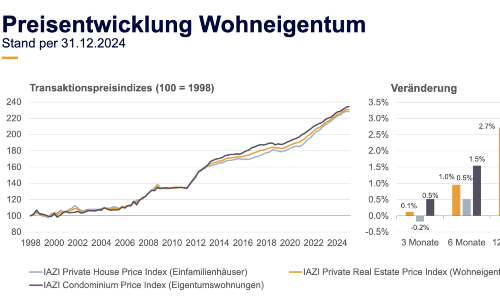
The transaction price indices calculated by IAZI show a decline of 0.3 percent for direct real estate investments such as apartment buildings in the fourth quarter compared to the previous quarter. A «moderate price growth» of 1.1 percent was observed in a year-on-year comparison.
(Click to enlarge; Graphic: IAZI)
The index tracks the price trends of investment properties with residential and mixed-use purposes, based on actual ownership changes in the open market.
The picture for residential property was mixed. While prices for single-family homes were lower 0.2 percent compared to the previous quarter, the willingness to pay for condominiums increased by 0.5 percent. Overall, this led to a slight increase of 0.1 percent in the value of owner-occupied homes and a year-on-year price growth of 2.7 percent, which is roughly in line with the long-term average.
2025 Starts with a Tailwind
However, the experts expect «some tailwind» for the start of 2025. «With the unexpectedly sharp reduction in key interest rates to just 0.5 percent, the Swiss National Bank has once again significantly improved the investment climate.»
Lower mortgage costs have increased the attractiveness of financing, both for ower-occupied residential property and investment properties. This is boosting demand from investors. There are also positive impulses from the economy as a whole and the tenant market.
Positive factors include the comparatively solid economy, the robust labor market, incomes and immigration.
Higher Mortgage Interest Rates Due to Basel III
However, the comprehensive changes to lending guidelines as part of the Basel III regulatory framework could have a negative impact, the report continues. «Among other things, banks will have to deposit more equity for financing with an increased proportion of borrowed capital, which will make such transactions more expensive or, depending on the initial situation, impossible.»
It is to be expected that any additional costs wil be passed on to customers. «Anyone who wants to purchase real estate and in particular apartment buildings as investment properties and requires bank financing for this must therefore expect higher mortgage interest rates, depending on the initial situation.»