
Fine Dining, Fine Wine, and a Fine Legacy: The Story of the Bindella Family
Taming Sangiovese
Around 1970, the three now-dominant players among Super-Tuscans had the idea to experiment with grape varieties. «Piero Antinori was the first to soften the sharpness of Sangiovese by blending it with Cabernet Sauvignon for the ‹Tignanello›,» Senior explains. At the same time, Marchese Mario Incisa della Rocchetta introduced Cabernet Sauvignon and Cabernet Franc to Bolgheri, inspired by Château Lafite-Rothschild.
In the 1980s, «Ornellaia» was added—a creation of Marchese Lodovico Antinori following the Bordeaux blend model. Today, «Ornellaia» belongs to the Marchesi de’ Frescobaldi.
21 Francs for the First Vintage
The first 1,200 bottles of «Tignanello» and «Sassicaia» were imported by Bindella around 1976. «They were completely unknown, and we brought them to Switzerland,» Senior recalls. He told his father, «We need to sell these wines for 20 or 21 francs a bottle.» His father responded skeptically: «Are you crazy? Nobody will pay that much for an Italian wine.»
But Senior ensured the wines made their debut at the still-running Expovina wine fair. «Everything was sold in three days,» he says.
Reliable Revenue Drivers
The trio of Super-Tuscans—«Tignanello», «Sassicaia», and «Ornellaia»—went on to achieve global success and became reliable revenue drivers for Bindella’s wine business. Today, hardly any respectable restaurant dares to exclude these iconic wines from their list. «The fantastic assemblage, the meticulous quality control, combined with excellent marketing: these wines are truly outstanding,» Senior remarks.
However, working with such prestigious producers comes with constant pressure. «We are under continuous scrutiny to ensure we’re doing a good job,» he adds.
Number One for «Tignanello»
As for «Tignanello», Switzerland is the world’s largest market on a per-capita basis. «In absolute sales figures, we rank fourth,» Junior adds.
Does this mean securing generous allocations for Switzerland is easy? «On the contrary,» the Bindellas reply in unison. It’s an annual struggle, and there have even been cuts to their allocations.
«Ristorante Ornellaia»: Reaching for the Stars
Reflecting on the supply challenges, Senior muses, «For the product’s positioning, it’s actually better if there’s scarcity.» However, he warns producers to be cautious about overpricing. «Once the consumer turns away, it’s difficult to win them back.»
The conversation shifts to «Ristorante Ornellaia», which the Bindellas launched in 2018 at the former Volksbank building on St. Annagasse in partnership with the Frescobaldi family. Their ambition was clear: to offer fine dining worthy of Michelin stars. «Italian hospitality, from pizzerias to gourmet restaurants,» Junior explains. «We wanted to see if we could succeed in fine dining.»
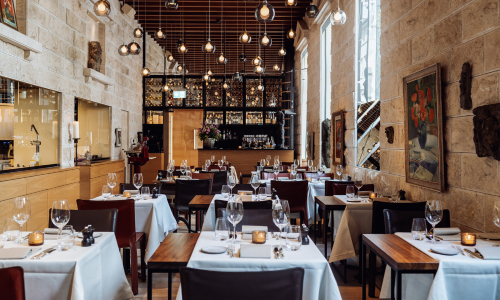
From Volksbank to Fine Dining: Bindella’s Ornellaia on St. Annagasse. (Image: Courtesy)
Giuseppe d’Errico and Antonio Colaianni
In terms of accolades, the concept was a success. The first head chef at «Ornellaia» was Giuseppe d’Errico, an Italian raised in France. The Bindellas recruited him from the «Maison Troisgros» near Lyon, a restaurant with three Michelin stars. Practically overnight, he elevated the Zurich restaurant to 17 Gault-Millau points and one Michelin star. Today, d’Errico runs «La Madernassa» in Alba, Piedmont.
His successor from fall 2020 to spring 2024 was Zurich’s beloved chef Antonio Colaianni who maintained the restaurant’s accolades with ease and now runs his own restaurant (as reported by finews.com).
The Cost Problem
Despite its culinary success, the Bindellas explain that the high costs of the prestigious location and the restaurant’s limited capacity—just 50 seats—posed a significant challenge. «Revenue was strong, but costs spiraled out of control,» Junior admits.
Senior adds candidly, «We gave it four years and had to acknowledge that it wasn’t sustainable in this format. This type of project is for people who can afford to cross-subsidize.» Michelin-starred chefs, he notes, are uncompromising about the quality of their dishes but less mindful of costs. Their investment partner Frescobaldi also began pressuring them: «You need to do something!»
A Successful Turnaround
The solution? A concept that remains ambitious—slightly more elevated than «Ristorante Bindella» but simpler and less costly than Michelin-starred dining.
The new approach recently earned 15 Gault-Millau points. «We aimed high and still landed at a good level,» Junior says. «Now it’s performing excellently from a business perspective.»
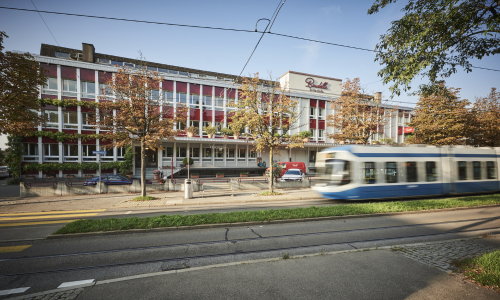
Joyful Italianità: Bindella Headquarters in Höngg, Zurich. (Image: Courtesy)
«Our Little Paradise»: Tenuta Vallocaia
When the conversation turns to wine, their eyes light up. A few years ago, the Bindellas opened their own winery, «Tenuta Vallocaia», in Montepulciano to the public. Located near the prestigious Bolgheri region, the winery produces around 250,000 bottles annually—a medium scale by international standards. «Size is relative, but quality is absolute,» Senior says. «Vallocaia is our little paradise. Viticulture, which we’ve practiced for over 60 years, is the key to understanding wine.»
The winery welcomed 6,000 visitors this year. Currently, Bindella is working to introduce its wines into upscale Swiss gastronomy. «Modernizing production has led to a quantum leap in quality,» Senior says. Unlike other Super-Tuscans, which often blend Sangiovese with Cabernet for broader appeal, Bindella bottles the grape as a pure varietal.
«Vergaia» with Philipp Hildebrand
Soon, the father and son reveal, a wine named «Vergaia» will hit the market. It’s a boutique winery in Bibbona initiated by BlackRock executive Philipp Hildebrand and now being developed in close collaboration with the Bindella family.
At this point, our rendezvous with Rudi Bindella Junior and Senior comes to an end. They must leave—for a bank meeting in Basel.
- << Back
- Page 2 of 2