ESG Backlash: From Scrutiny To Opportunity
Yet, to view this development as a simple rejection of sustainable principles would be to miss the bigger picture. This scrutiny is not happening in a vacuum; it follows a period of unprecedented growth that has seen assets in sustainable strategies grow sixfold since 2018.
This moment of questioning should not be seen as a threat. Instead, it presents a valuable opportunity to strengthen the very foundations of sustainable investing, allowing committed banks and asset managers to refine their approach and demonstrate their long-term vision.
A Victim of Its Own Success
The recent, intense focus on ESG has emerged directly from its rapid ascent into the financial mainstream. Morningstar estimates that assets in ESG and sustainability funds now represent over 20 per cent of all assets under management in Europe.
As ESG investing became more widespread, it was natural for its fund flows to begin mirroring broader industry trends. While the first quarter of 2025 did see the first-ever net outflows from sustainability funds, the amount represented a mere 0.2 per cent of total global assets in these funds - hardly a mass exodus. In July, Morningstar even reported that Q2 2025 saw a return of inflows to sustainable investment funds, more than offsetting Q1 outflows.
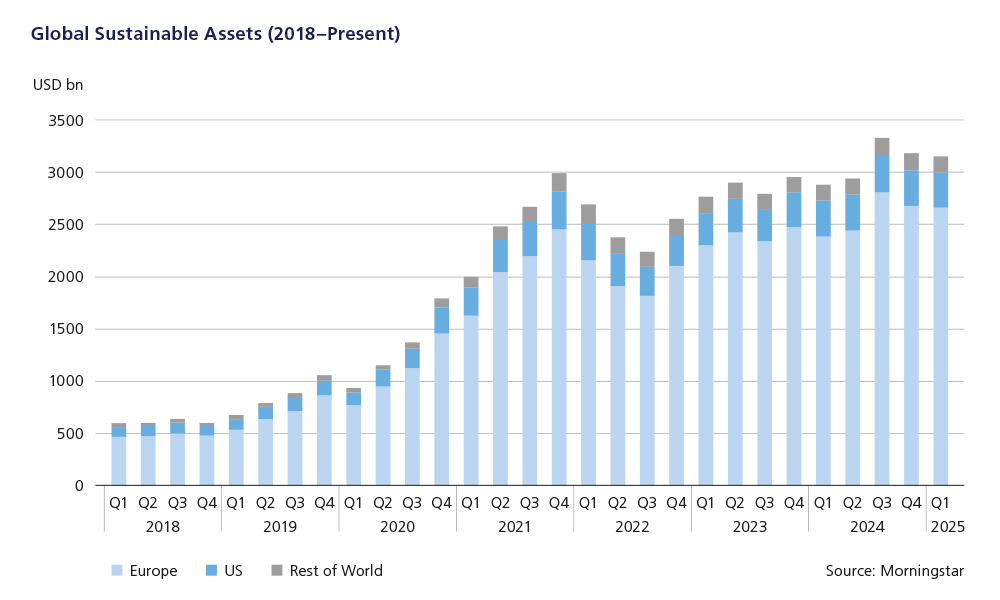
The «backlash,» therefore, appears less a material rejection by investors and more a natural consequence of success. With any rapid expansion comes growing pains and a need for greater diligence. This climate calls for financial institutions to navigate the scrutiny effectively and build a more compelling case for the benefits of sustainable strategies.
Back to Basics: The Financial Case
First and foremost, this environment demands a return to the foundational principles of fiduciary duty: the material, financial case for sustainable investment. A wealth of academic and professional studies has already shown that strong ESG practices can positively impact financial performance.
Research from MSCI, for instance, demonstrates that ESG criteria behave similarly to traditional financial factors and are positively correlated with performance. While ESG factors alone cannot predict a company’s valuation, they provide unique information that is critical to any robust investment process.
Crucially, sustainability should not be a separate, siloed strategy. At leading private banks and asset managers, it is integrated into the same fundamental investment process applied to all strategies.
Financial returns are still driven by strategic asset allocation, instrument selection, and risk management. Sustainable investing should be presented as a specific focus within this proven framework, helping clients understand that these strategies leverage all the essential aspects of a manager’s process that drive returns and manage downside risk.
A Sharper Lens on Risk and Reward
By focusing on financial materiality, it becomes clear that ESG data provides a broad spectrum of insights. These metrics are invaluable for identifying how effectively a company is managing external sustainability risks.
They offer a window into management’s focus on long-term issues and stakeholder relations, reflecting the overall quality of a company’s leadership – arguably the single most important factor driving long-term value.
Beyond risk management, sustainability helps investors identify attractive opportunities. Long-term megatrends such as the circular economy, water infrastructure, and the growing need for energy security are set to drive significant demand for new products and services.
By embedding sustainability within its core thematic research – rather than treating it as a separate topic – a financial institution can help clients recognize the powerful growth drivers that underpin the transition to a more sustainable future.
Beyond the Balance Sheet: Aligning with Values
Perhaps most importantly, financial institutions must make a clear link between their sustainable investment offerings and their long-term corporate strategy. Clients drawn to sustainable investing want to partner with an institution that takes it seriously – not as a commercial or marketing tactic, but as a practice consistent with the firm’s core values. For private banks, this means integrating sustainability into the primary investment offering.
When clients approach a bank, they expect the best advice to preserve and grow their wealth. If sustainability is material to the investment strategy, it should at a minimum be integrated into the default offering for all clients. This approach creates a powerful alignment of interests on sustainability between the bank and its clients, which is critical for building and maintaining trust.
The Next Chapter for Sustainable Investing
Ultimately, the recent ESG backlash should be viewed not as a challenge but as an opportunity. In 2025 alone, we have seen high-profile institutional investors switch asset managers based on sustainability performance.
Denmark’s AkademikerPension and the GBP 33 billion People’s Pension fund in the UK both announced they were moving mandates away from managers performing poorly on climate change issues. This trend highlights that the backlash is emerging as a commercial opportunity for managers to differentiate themselves for long-term, committed investors.
By re-emphasizing the financial case, focusing on material ESG risks and opportunities, and aligning offerings with core values, financial institutions can build on these developments. This allows them to return to first principles and provide a stronger foundation for future innovation and growth in their sustainable investing strategies.